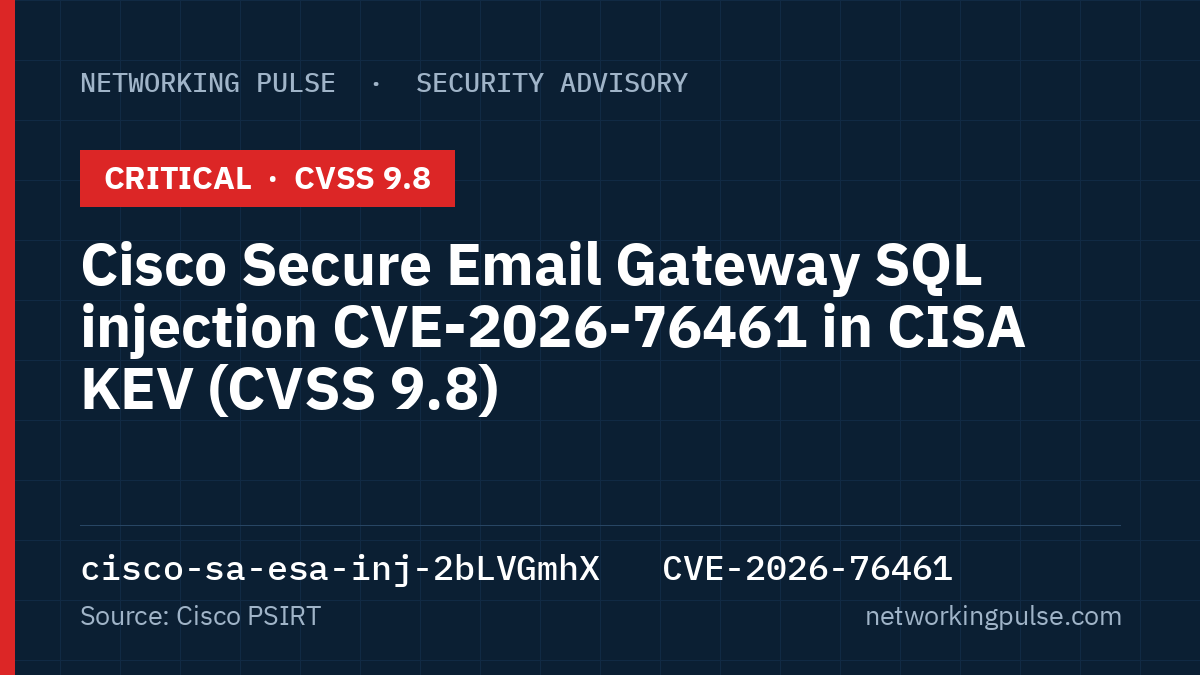
Cisco published security advisory cisco-sa-esa-inj-2bLVGmhX on 14 September 2026 and last updated it on 3 November 2026. It covers CVE-2026-76461, an SQL injection flaw in the email parsing of Cisco AsyncOS Software for Cisco Secure Email Gateway. An unauthenticated, remote attacker could run commands with root privileges on the underlying operating system. Cisco rates it Critical, with a CVSS 3.1 base score of 9.8. CISA added it to its Known Exploited Vulnerabilities (KEV) catalog on 14 September 2026. Cisco says it is aware of active exploitation. There are no workarounds; fixed releases are available.
Advisory details
| Field | Value (as published by Cisco) |
|---|---|
| Advisory ID | cisco-sa-esa-inj-2bLVGmhX |
| Title | Cisco Secure Email Gateway SQL Injection Vulnerability |
| Security impact rating | Critical |
| First published | 2026 September 14 16:00 GMT |
| Last updated | 2026 November 3 17:05 GMT (version 1.2, Final) |
| CVE ID | CVE-2026-76461 |
| Cisco bug ID | CSCwu56234 |
| Weakness | CWE-89 |
| CVSS 3.1 base score | 9.8 |
| CVSS 3.1 vector | CVSS:3.1/AV:N/AC:L/PR:N/UI:N/S:U/C:H/I:H/A:H/E:X/RL:X/RC:X |
| Workarounds | No workarounds available |
| Exploitation (per Cisco) | In September 2026, the Cisco PSIRT became aware of active exploitation of this vulnerability. |
| Source | Found during the resolution of a Cisco TAC support case. |
| Snort rules | 3:67109, 3:67110 |
| Revision history | 1.0 (2026-09-14): initial public release. 1.1 (2026-09-17): added clarification regarding clustered appliances. 1.2 (2026-11-03): updated information related to Release 15.5.5-014 in the Fixed Releases table. |
What the advisory says
Cisco's summary, quoted in full:
A vulnerability in the email parsing of Cisco AsyncOS Software for Cisco Secure Email Gateway could allow an unauthenticated, remote attacker to execute arbitrary commands with root privileges on the underlying operating system.
This vulnerability is due to insufficient validation in the email parsing logic. An attacker could exploit this vulnerability by sending a crafted email message that contains malicious SQL statements through an affected device. A successful exploit could allow the attacker to execute arbitrary SQL statements, leading to command execution with root privileges on the underlying operating system.
In short, an attacker only needs to send a crafted email through the gateway. No login is needed.
Affected products
Cisco says the flaw affects Cisco Secure Email Gateway, both physical and virtual, regardless of device configuration. Cisco has confirmed that it does not affect Secure Email and Web Manager or Secure Web Appliance.
Fixed releases
The table below reproduces every row of Cisco's fixed-release table.
| Cisco AsyncOS for Cisco Secure Email Gateway Software release | First fixed release |
|---|---|
| 15.5 and earlier | 15.5.5-014* |
| 16.0 | 16.0.4-302 |
| 16.5 | 16.5.0-780 |
*Cisco released an updated version of the fix in Release 15.5.5-014 on October 31, after new information about exploit code available online. To confirm the updated fix is installed, run the CLI command retroscannerstatus and check that Cisco Retro Remediation Engine is Version 4.0.2 or later. Release 16.5.0-780 already addresses the flaw regardless of the Retro Remediation Engine version.
Cisco strongly recommends that customers on releases earlier than 16.5 migrate to Release 16.5.0-780. Cisco has already upgraded all Cisco Secure Email Cloud devices to Release 16.5.0-780. The device reboots after an upgrade, whether done in the web interface (System Administration > System Upgrade) or the CLI (upgrade, then DOWNLOADINSTALL).
Indicators of compromise and recommendations
- Cisco advises reviewing the
mail_logsfor suspicious SQL statements, on every member of a cluster. Its example check isgrep -i "COPY.*TO PROGRAM"against the mail logs. Any output may indicate malicious activity. - Because a successful attack gives root access, evidence may be removed. Cisco recommends cross-checking network and firewall logs outside the device, including unexpected uploads to external IP addresses.
- Physical appliances where compromise is suspected: contact Cisco TAC, with remote access enabled.
- Virtual appliances where compromise is suspected: keep forensic information, deploy a new virtual machine on a fixed release, rebuild the configuration, renew credentials and cryptographic material, and keep monitoring.
- Clusters: private SSH keys used between cluster members could be accessed on a compromised appliance. Cisco recommends restoring every member of a cluster that has at least one compromised appliance.
- No compromise suspected: upgrade to a fixed release.
- Hardening: block internet access to the appliance or limit it to trusted hosts, separate mail and management interfaces, place the appliance behind a firewall, send logs to an external server, disable HTTP for the administrator portal and unneeded services, and use strong authentication such as SAML or LDAP.
Exploitation status
CISA lists CVE-2026-76461 in its KEV catalog as "Cisco Secure Email Gateway SQL Injection Vulnerability". It was added on 2026-09-14 with a due date of 2026-09-17. Known ransomware campaign use is listed as "Unknown". Cisco also states it is aware of active exploitation.
Terms explained
- Cisco Secure Email Gateway: Cisco's email security appliance, physical or virtual, that filters inbound and outbound mail. It runs Cisco AsyncOS Software.
- SQL injection: a flaw where input is treated as part of a database query, letting an attacker run their own SQL statements.
- CWE-89: the MITRE Common Weakness Enumeration entry "Improper Neutralization of Special Elements used in an SQL Command ('SQL Injection')".
- Root privileges: full administrative control of the operating system.
- Indicators of compromise: traces in logs or on a system that suggest an attack took place.
- KEV catalog: CISA's list of vulnerabilities with evidence of active exploitation.
The CVSS 3.1 vector, part by part
| Metric | Value | Meaning |
|---|---|---|
| AV:N | Attack Vector: Network | The attack can be sent over the network. |
| AC:L | Attack Complexity: Low | No special conditions are needed. |
| PR:N | Privileges Required: None | No account is needed. |
| UI:N | User Interaction: None | No user action is needed. |
| S:U | Scope: Unchanged | The impact stays within the vulnerable component. |
| C:H / I:H / A:H | Confidentiality, Integrity, Availability: High | A successful attack can fully affect all three. |
| E:X / RL:X / RC:X | Temporal metrics: Not Defined | Cisco did not set exploit maturity, remediation level or report confidence. |
What This Means for IT Teams
Every on-premises Secure Email Gateway, physical or virtual, on a release before the first fixed release is affected, whatever its configuration. Cloud-hosted gateways have already been upgraded by Cisco.
Administrators can check the AsyncOS release and upgrade, with Cisco recommending 16.5.0-780. Systems on 15.5.5-014 should confirm Retro Remediation Engine 4.0.2 or later. The appliance reboots after the upgrade.
Cisco also gives a mail-log check for attempted attacks and recommends reviewing network and firewall logs outside the device. Where compromise is suspected on a virtual appliance, Cisco recommends a rebuild on a fixed release rather than an upgrade alone. The CISA KEV listing makes the issue a priority item for vulnerability management.
Cross-check: NVD record
The NVD record (status "Analyzed", last modified 2026-09-15) carries the same description, Cisco's CVSS 3.1 vector AV:N/AC:L/PR:N/UI:N/S:U/C:H/I:H/A:H with score 9.8 (CRITICAL), and CWE-89. NVD lists no CVSS 4.0 score and no separate NVD score. NVD records the CISA KEV listing (added 2026-09-14, action due 2026-09-17). The CISA ADP entry in NVD rates exploitation as "active". NVD's configuration marks AsyncOS before 15.5.5-014, 16.0 before 16.0.4-302 and 16.5 before 16.5.0-780 as vulnerable, which matches Cisco's table. NVD does not reflect Cisco's 31 October update to the 15.5.5-014 fix.
Related coverage
For another recent Cisco advisory, see Cisco BroadWorks XXE flaw CVE-2026-20320.
Sources
- Cisco security advisory cisco-sa-esa-inj-2bLVGmhX: https://sec.cloudapps.cisco.com/security/center/content/CiscoSecurityAdvisory/cisco-sa-esa-inj-2bLVGmhX
- NVD API record for CVE-2026-76461: https://services.nvd.nist.gov/rest/json/cves/2.0?cveId=CVE-2026-76461
- CISA Known Exploited Vulnerabilities catalog (JSON feed): https://www.cisa.gov/sites/default/files/feeds/known_exploited_vulnerabilities.json