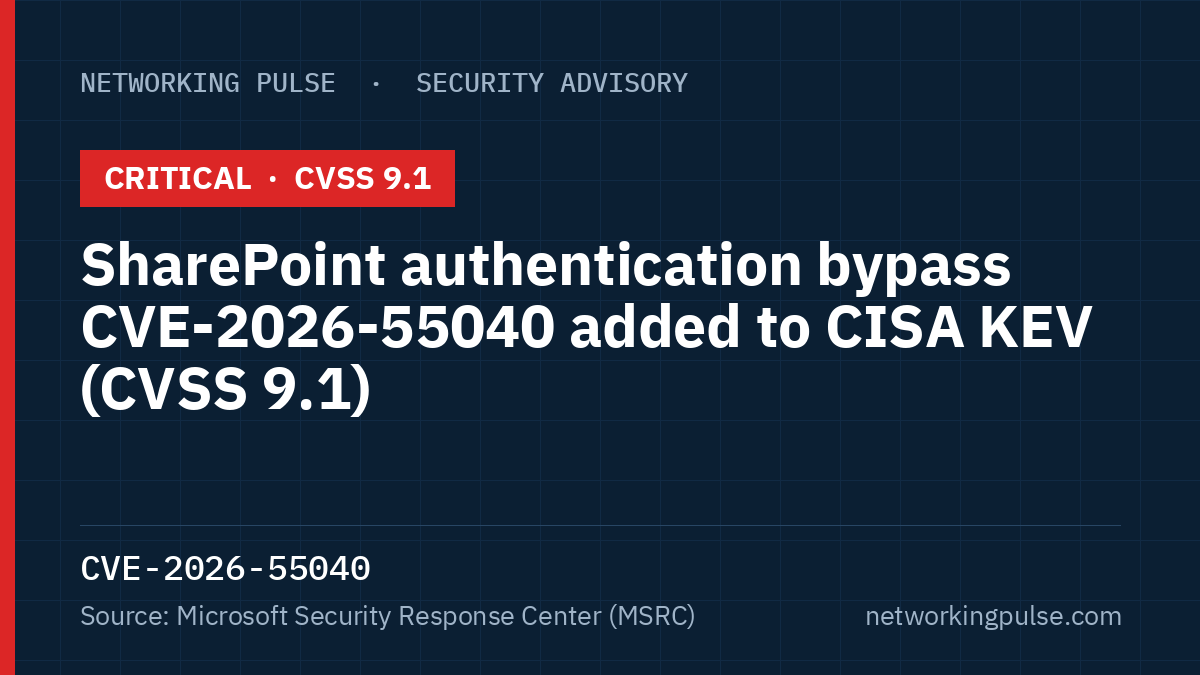
Microsoft released a security update for CVE-2026-55040 on 14 July 2026. The flaw is a weak authentication issue in Microsoft SharePoint Server. Microsoft says an unauthenticated attacker could bypass authentication over a network. Microsoft rates it Critical, with a CVSS 3.1 base score of 9.1. CISA added it to its Known Exploited Vulnerabilities (KEV) catalog on 18 August 2026. Updates are available for SharePoint Server Subscription Edition, 2019 and 2016.
Advisory details
| Field | Value (as published by Microsoft) |
|---|---|
| CVE ID | CVE-2026-55040 |
| Title | Microsoft SharePoint Server Security Feature Bypass Vulnerability |
| Released | 2026-07-14 (2026-Jul security release) |
| Last revision | Version 1, 2026-07-14: Information published. |
| Max severity | Critical |
| Impact | Security Feature Bypass |
| Weakness | CWE-1390: Weak Authentication |
| CVSS 3.1 base score | 9.1 |
| CVSS 3.1 temporal score | 7.9 |
| CVSS 3.1 vector | CVSS:3.1/AV:N/AC:L/PR:N/UI:N/S:U/C:H/I:H/A:N/E:U/RL:O/RC:C |
| Publicly disclosed (per Microsoft) | No |
| Exploited (per Microsoft, at release) | No |
| Exploitability assessment | Exploitation More Likely |
| Customer action required | Yes |
What the advisory says
Microsoft's description, quoted in full:
Weak authentication in Microsoft Office SharePoint allows an unauthorized attacker to bypass a security feature over a network.
Microsoft's FAQ adds these points:
- The authentication feature could be bypassed, because the flaw allows impersonation.
- In a network-based attack, an unauthenticated attacker could bypass authentication and make an anonymous connection.
- An attacker could disclose files and modify data, but cannot affect the availability of the system.
- The same KB number applies to both SharePoint Server 2016 and SharePoint Enterprise Server 2016. Customers running either version should install the security update.
Affected products and security updates
The table below reproduces every row of Microsoft's affected-products list for this CVE.
| Product | Severity | Impact | Article / download | Fixed build | Supersedes | Restart required |
|---|---|---|---|---|---|---|
| Microsoft SharePoint Server Subscription Edition | Critical | Security Feature Bypass | Security Update (KB5002882) | 16.0.19725.20434 | KB5002873 | Maybe |
| Microsoft SharePoint Server 2019 | Critical | Security Feature Bypass | Security Update (KB5002883) | 16.0.10417.20175 | KB5002874 | Maybe |
| Microsoft SharePoint Enterprise Server 2016 | Critical | Security Feature Bypass | Security Update (KB5002891) | 16.0.5561.1001 | KB5002880 | Maybe |
The KB articles are KB5002882, KB5002883 and KB5002891 on support.microsoft.com.
Exploitation status
CISA lists CVE-2026-55040 in its KEV catalog as "Microsoft SharePoint Weak Authentication Vulnerability". It was added on 2026-08-18 with a due date of 2026-08-21. Known ransomware campaign use is listed as "Unknown". Microsoft's advisory has not been revised since 14 July 2026 and still shows "Exploited: No". The exploitation status in this article is based on the later CISA listing.
Terms explained
- SharePoint Server: Microsoft's on-premises platform for intranet sites, document libraries and collaboration.
- Security feature bypass: Microsoft's impact class for flaws that defeat a protection, here authentication.
- Impersonation: acting as another user or identity without proving it.
- CWE-1390: the MITRE Common Weakness Enumeration entry "Weak Authentication".
- Fixed build: the product build number that contains the fix.
- KEV catalog: CISA's list of vulnerabilities with evidence of active exploitation.
The CVSS 3.1 vector, part by part
| Metric | Value | Meaning |
|---|---|---|
| AV:N | Attack Vector: Network | The attack can be sent over the network. |
| AC:L | Attack Complexity: Low | No special conditions are needed. |
| PR:N | Privileges Required: None | No account is needed. |
| UI:N | User Interaction: None | No user action is needed. |
| S:U | Scope: Unchanged | The impact stays within the vulnerable component. |
| C:H / I:H | Confidentiality, Integrity: High | Files can be disclosed and data modified. |
| A:N | Availability: None | The system stays available. |
| E:U | Exploit Code Maturity: Unproven | Microsoft's temporal value at release, 14 July 2026. CISA's KEV listing came later. |
| RL:O | Remediation Level: Official Fix | An official update exists. |
| RC:C | Report Confidence: Confirmed | The vendor has confirmed the flaw. |
What This Means for IT Teams
The issue applies to on-premises SharePoint Server Subscription Edition, SharePoint Server 2019 and SharePoint Server 2016, including Enterprise Server 2016. Microsoft lists no other affected products.
Administrators can compare each farm's build number with the fixed builds in the table, then install the matching security update. Microsoft marks the restart requirement as "Maybe". The advisory lists no workaround or mitigation.
No account or user action is needed for a successful attack. The flaw is on the CISA KEV list, so it is a priority item for patch management and vulnerability management.
Cross-check: NVD record
The NVD record (status "Analyzed", last modified 2026-08-19) carries the same description. It shows Microsoft's CVSS 3.1 vector AV:N/AC:L/PR:N/UI:N/S:U/C:H/I:H/A:N with score 9.1 (CRITICAL) and CWE-1390. NVD lists no CVSS 4.0 score and no separate NVD score. NVD records the CISA KEV listing (added 2026-08-18, action due 2026-08-21). The CISA ADP entry in NVD rates exploitation as "active" and technical impact as "total". NVD's configuration covers Subscription Edition before 16.0.19725.20434, which matches Microsoft's fixed build, and SharePoint Server 2019 and Enterprise Server 2016 without version bounds.
Related coverage
For another recent Microsoft advisory, see Windows NTLM spoofing flaw CVE-2026-121680.
Sources
- Microsoft Security Response Center, CVE-2026-55040: https://msrc.microsoft.com/update-guide/vulnerability/CVE-2026-55040
- Microsoft Security Update Guide API, affected products for CVE-2026-55040: https://api.msrc.microsoft.com/sug/v2.0/en-US/affectedProduct?$filter=cveNumber%20eq%20'CVE-2026-55040'
- NVD API record for CVE-2026-55040: https://services.nvd.nist.gov/rest/json/cves/2.0?cveId=CVE-2026-55040
- CISA Known Exploited Vulnerabilities catalog (JSON feed): https://www.cisa.gov/sites/default/files/feeds/known_exploited_vulnerabilities.json