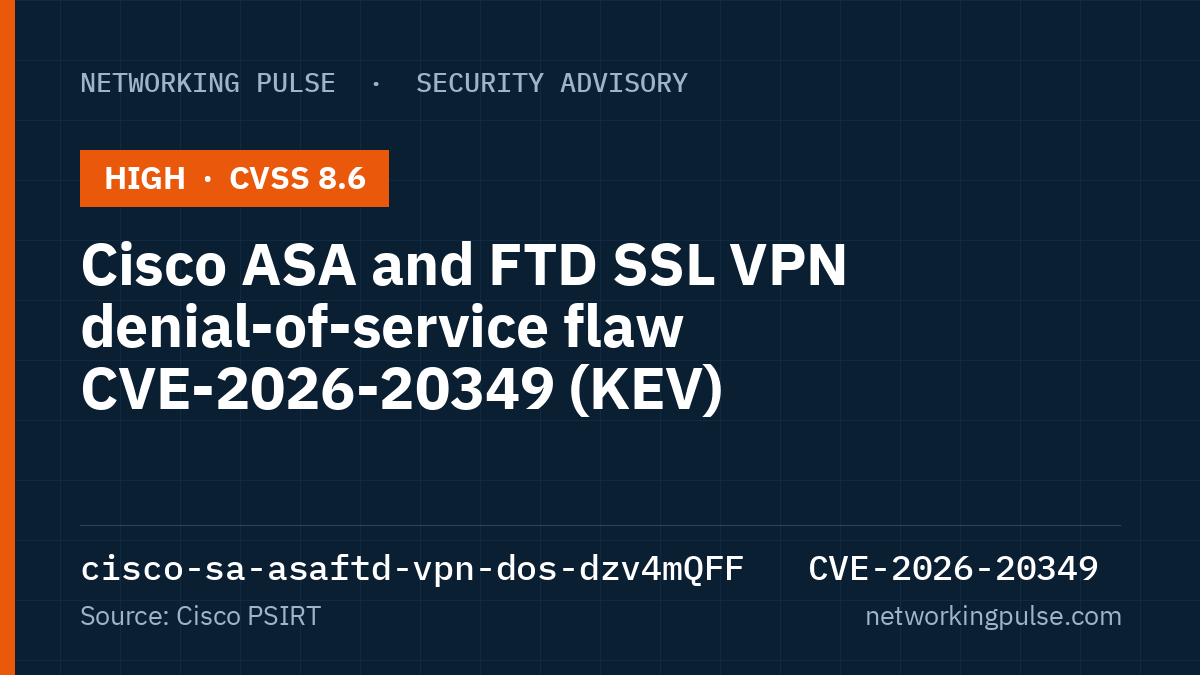
Cisco published security advisory cisco-sa-asaftd-vpn-dos-dzv4mQFF on 11 August 2026 and updated it on 16 September 2026. It covers CVE-2026-20349, a flaw in the Remote Access SSL VPN service of Cisco Secure Firewall ASA Software and Cisco Secure Firewall Threat Defense (FTD) Software. An unauthenticated, remote attacker could make an affected device reload, causing a denial of service. Cisco rates it High, with a CVSS 3.1 base score of 8.6. CISA added it to its Known Exploited Vulnerabilities (KEV) catalog on 11 August 2026. Cisco says it is aware of active exploitation. There are no workarounds; fixed releases are available.
Advisory details
| Field | Value (as published by Cisco) |
|---|---|
| Advisory ID | cisco-sa-asaftd-vpn-dos-dzv4mQFF |
| Title | Cisco Secure Firewall Adaptive Security Appliance and Secure Firewall Threat Defense Software Remote Access SSL VPN Denial of Service Vulnerability |
| Security impact rating | High |
| First published | 2026 August 11 16:39 GMT |
| Last updated | 2026 September 16 16:05 GMT (version 1.1, Final) |
| CVE ID | CVE-2026-20349 |
| Cisco bug ID | CSCwv96220 |
| Weakness | CWE-244 |
| CVSS 3.1 base score | 8.6 |
| CVSS 3.1 vector | CVSS:3.1/AV:N/AC:L/PR:N/UI:N/S:C/C:N/I:N/A:H/E:X/RL:X/RC:X |
| Workarounds | No workarounds available |
| Exploitation (per Cisco) | In August 2026, the Cisco PSIRT became aware of active exploitation of this vulnerability. |
| Source | Found during internal security testing; also reported to Cisco by Valerio Brussani - @val_brux (harmonyguard.cloud). |
| Snort rules | 46897, 59654 |
What the advisory says
Cisco's summary, quoted in full:
A vulnerability in the Remote Access SSL VPN service for Cisco Secure Firewall Adaptive Security Appliance (ASA) Software and Cisco Secure Firewall Threat Defense (FTD) Software could allow an unauthenticated, remote attacker to cause the device to reload unexpectedly, resulting in a denial of service (DoS) condition.
This vulnerability is due to insufficient error checking when processing HTTP requests. An attacker could exploit this vulnerability by sending a crafted HTTP request to the Remote Access SSL VPN service on an affected device. A successful exploit could allow the attacker to cause the affected device to reload, resulting in a DoS condition.
In short, a crafted HTTP request to the VPN service can make the firewall restart.
Vulnerable configurations
Cisco says a device is affected only if it runs a vulnerable release and has one or more of these features enabled. These features can enable the SSL listen sockets. The right column shows the basic configuration as seen in show running-config.
| Cisco Secure Firewall ASA and FTD Software feature | Possible vulnerable configuration |
|---|---|
| IKEv2 Remote Access VPN (with client services) (1) | crypto ikev2 enable <interface_name> client-services port <port_numbers> |
| SSL VPN (1) | webvpn / enable <interface_name> |
| Zero Trust Network Access (2) | zero-trust / enable |
(1) For Cisco Secure FTD Software, remote access VPN features are enabled from Devices > VPN > Remote Access in Cisco Secure Firewall Management Center (FMC) Software or from Remote Access VPN in Cisco Secure Firewall Device Manager (FDM).
(2) This feature is available only in Cisco Secure FTD Software.
Cisco has confirmed that the flaw does not affect Cisco Secure Firewall Management Center (FMC) Software.
Fixed releases
The tables below reproduce every row of Cisco's fixed-release tables. The left column is the release train. The right column is the first release that includes the fix.
Cisco Secure Firewall ASA Software
| Cisco Secure Firewall ASA Software release | First fixed release |
|---|---|
| 9.16 and earlier | 9.16.4.103 |
| 9.18 | 9.18.4.94 |
| 9.20 | 9.20.4.49 |
| 9.22 | 9.22.3.26 |
| 9.23 | 9.23.1.47 |
| 9.24 | 9.24.1.26 |
Cisco Secure FTD Software
| Cisco Secure FTD Software release and Secure FMC Software release | First fixed release |
|---|---|
| 7.0 and earlier | 7.0.10 |
| 7.2 | 7.2.12 |
| 7.4 | 7.4.8 |
| 7.6 | 7.6.6 |
| 7.7 | 7.7.13 |
| 10.0 | 10.0.2 |
| 10.1 | 10.1.0 |
Cisco notes that hot fixes were provided earlier. The hardening releases above now include this fix and fixes for other internally found issues. Cisco recommends upgrading to the appropriate hardening release. Cisco also offers the Cisco Software Checker to check a specific release.
Exploitation status
CISA lists CVE-2026-20349 in its KEV catalog as "Cisco Secure Firewall Adaptive Security Appliance (ASA) and Secure Firewall Threat Defense (FTD) Heap Inspection Vulnerability". It was added on 2026-08-11 with a due date of 2026-08-14. Known ransomware campaign use is listed as "Unknown". The vendor advisory also states that Cisco is aware of active exploitation.
Terms explained
- Cisco Secure Firewall ASA: Cisco's Adaptive Security Appliance firewall software.
- Cisco Secure Firewall Threat Defense (FTD): Cisco's firewall software that can be managed from Cisco Secure Firewall Management Center (FMC) or Firewall Device Manager (FDM).
- Remote Access SSL VPN: a service that lets remote users connect to the internal network through an encrypted tunnel over HTTPS.
- Denial of service (DoS): an attack that makes a system unavailable. Here the device reloads (restarts).
- CWE-244: the MITRE Common Weakness Enumeration entry "Improper Clearing of Heap Memory Before Release ('Heap Inspection')".
- KEV catalog: CISA's list of vulnerabilities with evidence of active exploitation.
The CVSS 3.1 vector, part by part
| Metric | Value | Meaning |
|---|---|---|
| AV:N | Attack Vector: Network | The attack can be sent over the network. |
| AC:L | Attack Complexity: Low | No special conditions are needed. |
| PR:N | Privileges Required: None | No account is needed. |
| UI:N | User Interaction: None | No user action is needed. |
| S:C | Scope: Changed | The impact reaches beyond the vulnerable component. |
| C:N / I:N | Confidentiality, Integrity: None | No data is read or changed. |
| A:H | Availability: High | A successful attack can stop the device from working. |
| E:X / RL:X / RC:X | Temporal metrics: Not Defined | Cisco did not set exploit maturity, remediation level or report confidence. |
What This Means for IT Teams
The issue applies to ASA and FTD devices that run an affected release and have IKEv2 remote access VPN with client services, SSL VPN, or (on FTD) Zero Trust Network Access enabled. Devices without these features are not listed as vulnerable. Management Center software is not affected.
Administrators can compare the installed release with the fixed-release tables, and check the running configuration for the listed commands. Cisco lists no workaround, so the remedy is an upgrade to the first fixed release or later for each release train.
No login or user action is needed for a successful attack, and the result is a device reload rather than data access. Because the flaw is on the CISA KEV list and Cisco reports active exploitation, it is a priority item for vulnerability management.
Cross-check: NVD record
The NVD record (status "Analyzed", last modified 2026-10-26) carries the same description, Cisco's CVSS 3.1 vector AV:N/AC:L/PR:N/UI:N/S:C/C:N/I:N/A:H with score 8.6 (HIGH), and CWE-244. NVD lists no CVSS 4.0 score and no separate NVD score. NVD records the CISA KEV listing (added 2026-08-11, action due 2026-08-14). The CISA ADP entry in NVD rates exploitation as "active". NVD's version list names affected ASA and FTD releases but not fixed releases; the fixed releases above come from Cisco.
Related coverage
For another recent Cisco advisory, see Cisco BroadWorks XXE flaw CVE-2026-20320.
Sources
- Cisco security advisory cisco-sa-asaftd-vpn-dos-dzv4mQFF: https://sec.cloudapps.cisco.com/security/center/content/CiscoSecurityAdvisory/cisco-sa-asaftd-vpn-dos-dzv4mQFF
- NVD API record for CVE-2026-20349: https://services.nvd.nist.gov/rest/json/cves/2.0?cveId=CVE-2026-20349
- CISA Known Exploited Vulnerabilities catalog (JSON feed): https://www.cisa.gov/sites/default/files/feeds/known_exploited_vulnerabilities.json