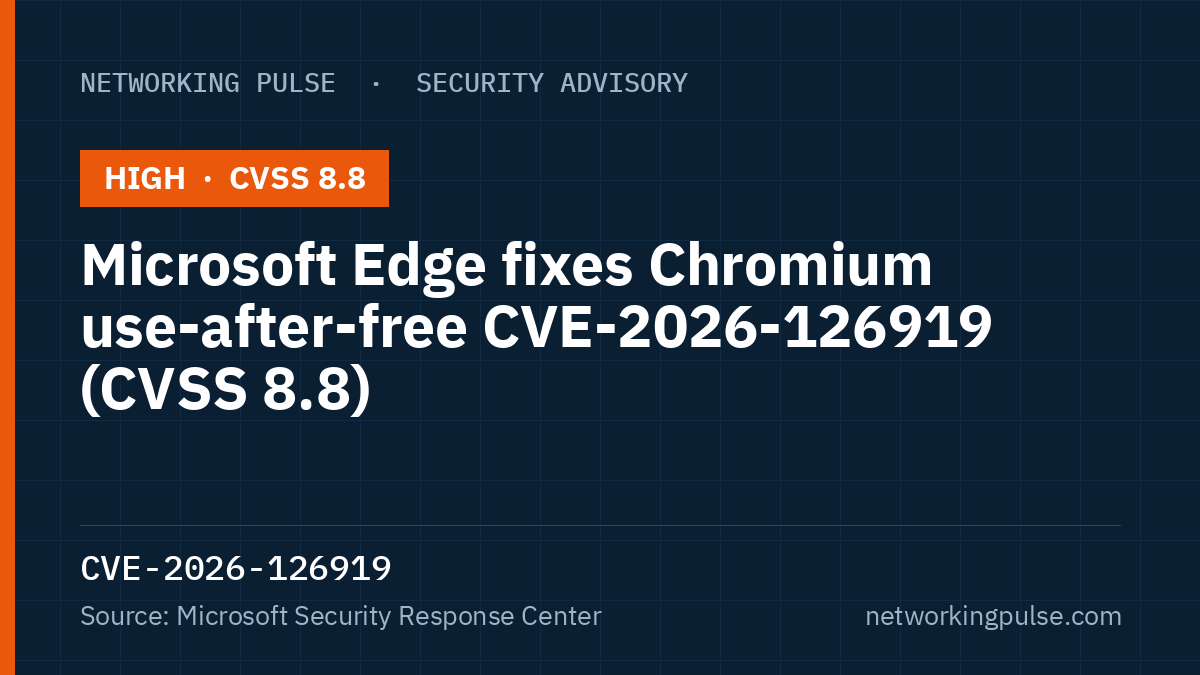
Microsoft listed CVE-2026-126919 in its Security Update Guide on 13 November 2026. It is a use-after-free weakness (CWE-416) in Chromium, the open-source browser engine that Microsoft Edge is built on. Google's Chrome team assigned the CVE. Microsoft documents it because the latest Microsoft Edge (Chromium-based) release is no longer vulnerable. The CVSS 3.1 base score is 8.8. The fixed Edge build is 157.0.4341.57.
Advisory details
| Field | Value (as published by Microsoft) |
|---|---|
| CVE ID | CVE-2026-126919 |
| Title | Chromium CVE-2026-126919: Use after free |
| Released | 2026-11-13 (release 2026-Nov) |
| Latest revision | Version 1, 2026-11-13: Information published. |
| Assigning CNA | Chrome |
| Weakness | CWE-416: Use After Free |
| CVSS 3.1 base score | 8.8 |
| CVSS 3.1 temporal score | 8.8 |
| CVSS 3.1 vector | CVSS:3.1/AV:N/AC:L/PR:N/UI:R/S:U/C:H/I:H/A:H |
| Max severity (Microsoft rating) | Important |
| Customer action required | Yes |
What the advisory says
Microsoft's description, quoted in full:
This CVE was assigned by Chrome. Microsoft Edge (Chromium-based) ingests Chromium, which addresses this vulnerability. Please see Google Chrome Releases for more information.
Microsoft's FAQ adds that the CVE appears in the Security Update Guide "to announce that the latest version of Microsoft Edge (Chromium-based) is no longer vulnerable".
The NVD record gives the technical detail. A use after free in BrowserTag in Google Chrome before 157.0.8103.78 allowed a remote attacker to run arbitrary code inside the sandbox via a crafted HTML page. Chromium rates the issue High.
Affected product and fix
The table reproduces every row of Microsoft's affected-products list for this CVE.
| Product | Product family | Severity | Impact | Fixed build | Article | Download | Reboot required |
|---|---|---|---|---|---|---|---|
| Microsoft Edge (Chromium-based) | Browser | Important | None listed | 157.0.4341.57 | Release Notes | Security Update | No |
To check the installed version, Microsoft says to open the three-dot menu (...) at the right of the Edge window, choose Help and Feedback, then About Microsoft Edge.
For Google Chrome, the NVD record says versions before 157.0.8103.78 are affected.
Known attacks
CVE-2026-126919 is not listed in the CISA KEV catalog, version 2026.11.13. KEV is CISA's list of flaws with confirmed real-world attacks. Microsoft's entry makes no statement about attacks. It is not known to be exploited.
Terms explained
- Chromium: the open-source browser project behind Google Chrome. Microsoft says Microsoft Edge (Chromium-based) ingests Chromium.
- Use after free (CWE-416): a memory error. A program keeps using a block of memory after it has released it. An attacker may be able to place their own data in that memory and change what the program does.
- Sandbox: a restricted area in which the browser runs web content. Code running "inside the sandbox" has limited access to the rest of the computer.
- Crafted HTML page: a web page built on purpose to trigger the flaw when the browser loads it.
- CNA (CVE Numbering Authority): an organisation allowed to assign CVE IDs. Here it is Google's Chrome team.
The CVSS 3.1 vector, part by part
| Metric | Value | Meaning |
|---|---|---|
| AV:N | Attack Vector: Network | The attack can come over a network, for example from a web page. |
| AC:L | Attack Complexity: Low | No special conditions are needed. |
| PR:N | Privileges Required: None | The attacker needs no account on the target. |
| UI:R | User Interaction: Required | A user must take an action, such as opening the crafted page. |
| S:U | Scope: Unchanged | The impact stays within the vulnerable component. |
| C:H / I:H / A:H | Confidentiality, Integrity, Availability: High | A successful attack can fully affect all three. |
Cross-check: NVD record
NVD published the record on 11 November 2026; its status was "Undergoing Analysis" when retrieved. It shows the same CVSS 3.1 vector and base score, 8.8 (HIGH), from CISA's secondary assessment. NVD has not published its own score. It lists CWE-416, the same weakness as Microsoft.
Differences: Microsoft rates the Edge entry "Important", while NVD shows HIGH and Chromium rates it High. Microsoft's entry does not name the affected component; NVD names BrowserTag. NVD covers Google Chrome versions; Microsoft covers Microsoft Edge builds.
Sources
- Microsoft Security Update Guide, CVE-2026-126919: https://msrc.microsoft.com/update-guide/vulnerability/CVE-2026-126919
- NVD API record, CVE-2026-126919: https://services.nvd.nist.gov/rest/json/cves/2.0?cveId=CVE-2026-126919
- CISA KEV catalog (JSON feed): https://www.cisa.gov/sites/default/files/feeds/known_exploited_vulnerabilities.json