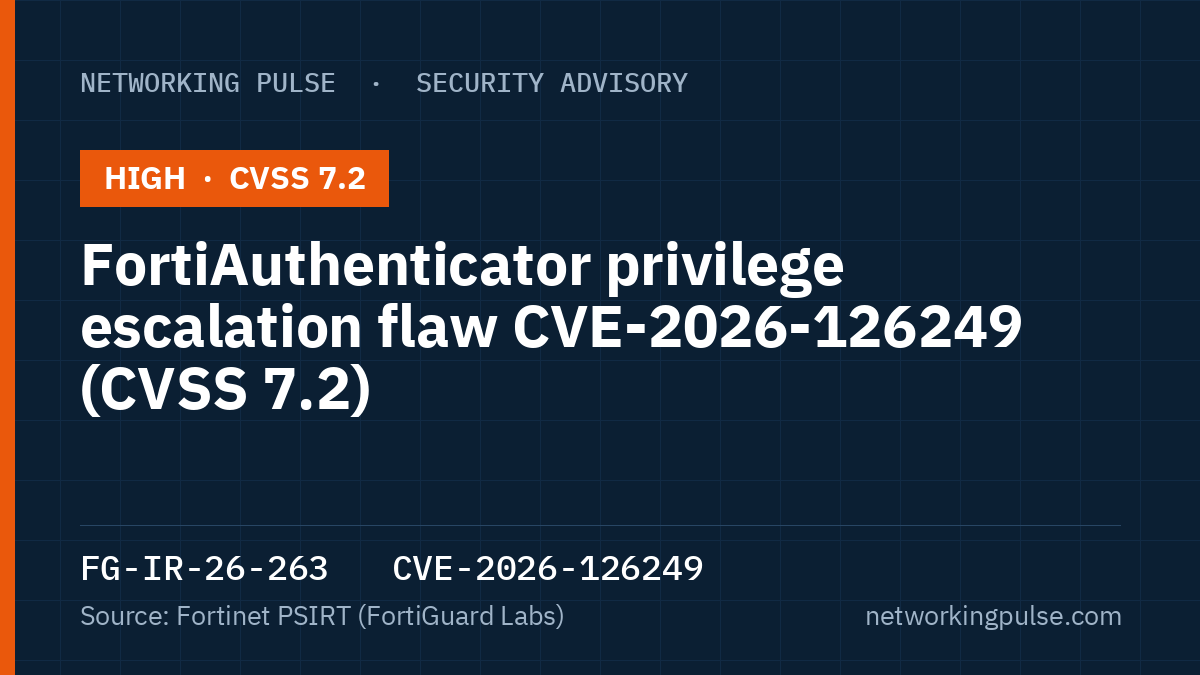
Fortinet published PSIRT advisory FG-IR-26-263 on 10 November 2026. It covers CVE-2026-126249, an improper privilege management weakness in FortiAuthenticator. Fortinet rates it High, with a CVSSv3 score of 7.2. An authenticated attacker may escalate privileges. Fixed releases are FortiAuthenticator 8.0.4 and 6.6.11.
Advisory details
| Field | Value (as published by Fortinet) |
|---|---|
| Advisory ID | FG-IR-26-263 |
| Title | Improper privilege management |
| Published | 2026-11-10 |
| CVE ID | CVE-2026-126249 |
| Severity | High |
| CVSSv3 score | 7.2 |
| CVSSv3 vector | AV:N/AC:L/PR:H/UI:N/S:U/C:H/I:H/A:H/E:P/RL:O/RC:C |
| Weakness | CWE-269: Improper Privilege Management |
| Impact | Escalation of privilege |
| Component | GUI |
| Attack type | Authenticated |
| Discovered | Internal |
| Known attacks (per Fortinet) | No (not known to be exploited) |
| Virtual patch | No |
| Workarounds | None listed |
| Acknowledgement | Internally discovered and reported by Gwendal Guegniaud of the Fortinet Product Security team with the use of the frontier AI model: Claude Mythos. |
| Timeline | 2026-11-10: Initial publication |
What the advisory says
Fortinet's summary, quoted in full:
An Improper Privilege Management vulnerability[CWE-269] in FortiAuthenticator may allow an authenticated attacker to escalate privileges.
The advisory names the GUI as the affected component. It does not give further technical detail.
Affected versions and solutions
The table below reproduces every row of the vendor's table, as published.
| Version | Affected | Solution |
|---|---|---|
| FortiAuthenticator 8.0 | 8.0.0 through 8.0.3 | Upgrade to 8.0.4 or above |
| FortiAuthenticator 6.6 | 6.6.0 through 6.6.10 | Upgrade to 6.6.11 or above |
The advisory lists no other branches and no cloud editions.
Known attacks
Fortinet lists the issue as not known to be exploited. The CVE is not in the CISA KEV catalog, version 2026.11.13. Absence from KEV does not prove that no attacks have happened.
Terms explained
- FortiAuthenticator: Fortinet's user authentication appliance.
- GUI: the graphical web interface used to administer the appliance.
- Privilege escalation: a user gains rights beyond those their account should have.
- Improper privilege management (CWE-269): the software does not correctly assign, check or limit user privileges.
- AV:N (Attack Vector: Network): the attack can be sent over a network.
- AC:L (Attack Complexity: Low): no special conditions are needed.
- PR:H (Privileges Required: High): the attacker must already hold a privileged account.
- UI:N (User Interaction: None): no other user has to do anything.
- S:U (Scope: Unchanged): the impact stays within the affected component.
- C:H, I:H, A:H: high impact on confidentiality, integrity and availability.
- E:P (Exploit Code Maturity: Proof-of-Concept): a temporal metric. Proof-of-concept code exists.
- RL:O (Remediation Level: Official Fix): the vendor has released a fix.
- RC:C (Report Confidence: Confirmed): the vendor has confirmed the issue.
What This Means for IT Teams
The advisory covers FortiAuthenticator 8.0.0 to 8.0.3 and 6.6.0 to 6.6.10. No other branches are listed.
Administrators can check the firmware version on each FortiAuthenticator and upgrade to 8.0.4 or 6.6.11 or later. Fortinet lists no workaround.
The attack needs an authenticated account; the CVSS vector rates the required privileges as high. Fortinet does not list the issue as known to be exploited. Tracking the upgrade through routine vulnerability management is a proportionate response.
NVD cross-check
The NVD record was published on 11 November 2026 and is Awaiting Analysis. NVD shows Fortinet's CVSS 3.1 base vector, CVSS:3.1/AV:N/AC:L/PR:H/UI:N/S:U/C:H/I:H/A:H, score 7.2, High. This matches the advisory. NVD lists no CVSS 4.0 score. NVD lists the same weakness, CWE-269.
NVD's affected ranges match the advisory: 8.0.0 through 8.0.3 and 6.6.0 through 6.6.10.
Sources
- Fortinet PSIRT: FG-IR-26-263, Improper privilege management
- NIST NVD: CVE-2026-126249 record (NVD API)
- CISA: KEV catalog (JSON feed)
Related coverage: Windows ICS privilege escalation flaw CVE-2026-119861 (CVSS 7.0).