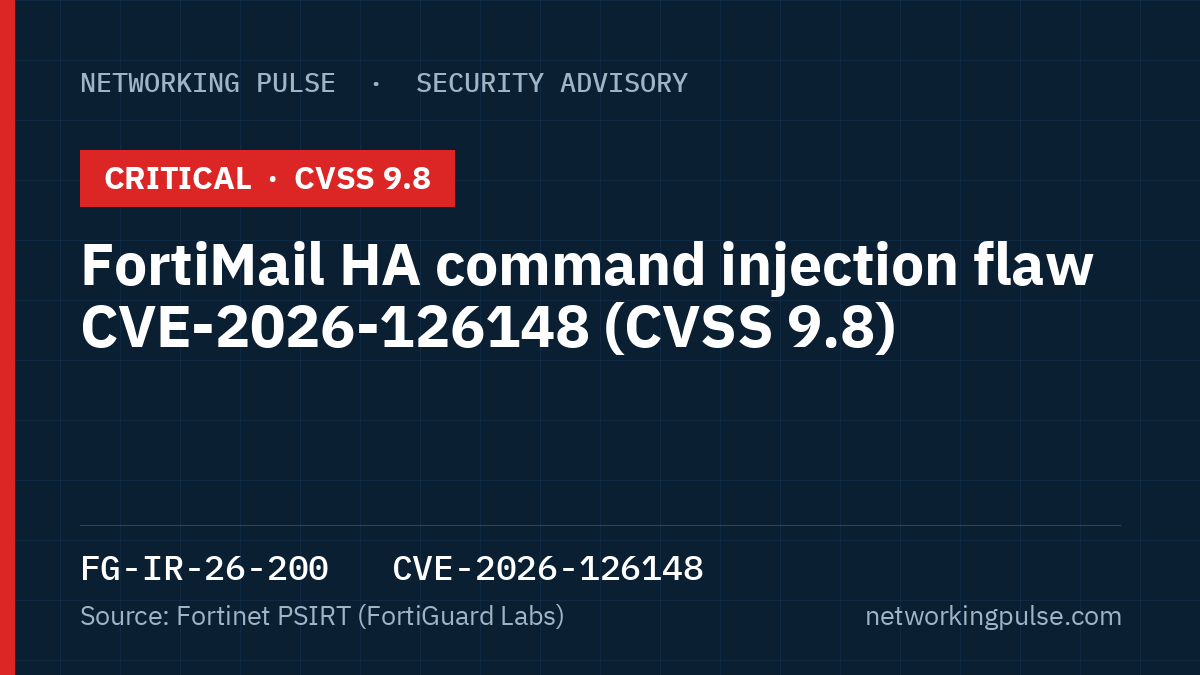
Fortinet published PSIRT advisory FG-IR-26-200 on 10 November 2026. It covers CVE-2026-126148, a command injection weakness in FortiMail. Fortinet rates it Critical, with a CVSSv3 score of 9.8. An unauthenticated attacker may run commands through crafted HA join-request packets. Fixed releases are FortiMail 8.0.2 and 7.6.7.
Advisory details
| Field | Value (as published by Fortinet) |
|---|---|
| Advisory ID | FG-IR-26-200 |
| Title | Improper neutralization of special elements used in an os command |
| Published | 2026-11-10 |
| CVE ID | CVE-2026-126148 |
| Severity | Critical |
| CVSSv3 score | 9.8 |
| CVSSv3 vector | AV:N/AC:L/PR:N/UI:N/S:U/C:H/I:H/A:H/E:P/RL:O/RC:R |
| Weakness | CWE-77: Improper Neutralization of Special Elements used in a Command ('Command Injection') |
| Impact | Execute unauthorized code or commands |
| Component | CLI |
| Attack type | Unauthenticated |
| Discovered | Internal |
| Known attacks (per Fortinet) | No (not known to be exploited) |
| Virtual patch | No |
| Workarounds | None listed |
| Acknowledgement | Internally discovered and reported by Theo Leleu of the Fortinet Product Security team with the use of frontier AI models. |
| Timeline | 2026-11-10: Initial publication |
What the advisory says
Fortinet's summary, quoted in full:
An Improper neutralization of special elements used in a command ('command injection') [CWE-77] in FortiMail may allow an unauthenticated attacker to execute unauthorized code or commands via crafted HA join-request packets.
In plain terms, FortiMail does not safely handle certain data in HA join requests. An attacker who can send such packets may get the appliance to run commands. No login is needed.
Affected versions and solutions
The table below reproduces every row of the vendor's table, as published.
| Version | Affected | Solution |
|---|---|---|
| FortiMail 8.0 | 8.0.0 through 8.0.1 | Upgrade to 8.0.2 or above |
| FortiMail 7.6 | 7.6.0 through 7.6.6 | Upgrade to 7.6.7 or above |
| FortiMail 7.4 | Not affected | Not Applicable |
| FortiMail 7.2 | Not affected | Not Applicable |
Fortinet says it fixed FortiMail Cloud on 5 October 2026. It updated all firmware to 7.6.7 GA or 8.0.2 GA. FortiMail Cloud customers do not need to take any action.
Known attacks
Fortinet lists the issue as not known to be exploited. The CVE is not in the CISA Known Exploited Vulnerabilities (KEV) catalog, version 2026.11.13. Absence from KEV does not prove that no attacks have happened.
Terms explained
- FortiMail: Fortinet's email security gateway. It filters inbound and outbound mail.
- HA (high availability): two or more FortiMail units work as a cluster, so one can take over if another fails. A join request is the message a unit sends to join that cluster.
- Command injection (CWE-77): input is passed to a command without proper filtering. Special characters can then change the command or add new ones.
- OS command injection (CWE-78): the same flaw, where the command goes to the operating system shell. NVD lists this CWE.
- AV:N (Attack Vector: Network): the attack can be sent over a network.
- AC:L (Attack Complexity: Low): no special conditions are needed.
- PR:N (Privileges Required: None): the attacker needs no account.
- UI:N (User Interaction: None): no user has to do anything.
- S:U (Scope: Unchanged): the impact stays within the affected component.
- C:H, I:H, A:H: high impact on confidentiality, integrity and availability.
- E:P (Exploit Code Maturity: Proof-of-Concept): a temporal metric. Proof-of-concept code exists for the issue.
- RL:O (Remediation Level: Official Fix): the vendor has released a fix.
- RC:R (Report Confidence: Reasonable): the vendor rates confidence in the technical details as reasonable.
What This Means for IT Teams
The advisory names on-premises FortiMail 8.0.0 to 8.0.1 and 7.6.0 to 7.6.6. Branches 7.4 and 7.2 are not affected. FortiMail Cloud was already updated by Fortinet.
Administrators can check the firmware version on each FortiMail unit and plan an upgrade to 8.0.2 or 7.6.7 or later. Fortinet lists no workaround, so the upgrade is the documented fix.
The attack needs no login and no user action, but it relies on HA join-request packets reaching the appliance. Fortinet does not list the issue as known to be exploited. Tracking it through routine vulnerability management and patch management is a proportionate response.
NVD cross-check
The NVD record was published on 11 November 2026 and is Awaiting Analysis. NVD shows Fortinet's CVSS 3.1 base vector, CVSS:3.1/AV:N/AC:L/PR:N/UI:N/S:U/C:H/I:H/A:H, score 9.8, Critical. This matches the advisory. NVD lists no CVSS 4.0 score. NVD's affected ranges match the advisory: 8.0.0 through 8.0.1 and 7.6.0 through 7.6.6.
One difference: NVD lists the weakness as CWE-78 (OS command injection). The advisory page cites CWE-77 (command injection). The NVD description also says "os command injection".
Sources
- Fortinet PSIRT: FG-IR-26-200, Improper neutralization of special elements used in an os command
- NIST NVD: CVE-2026-126148 record (NVD API)
- CISA: KEV catalog (JSON feed)
Related coverage: Windows NTLM spoofing flaw CVE-2026-121680 can leak NTLMv2 hashes.