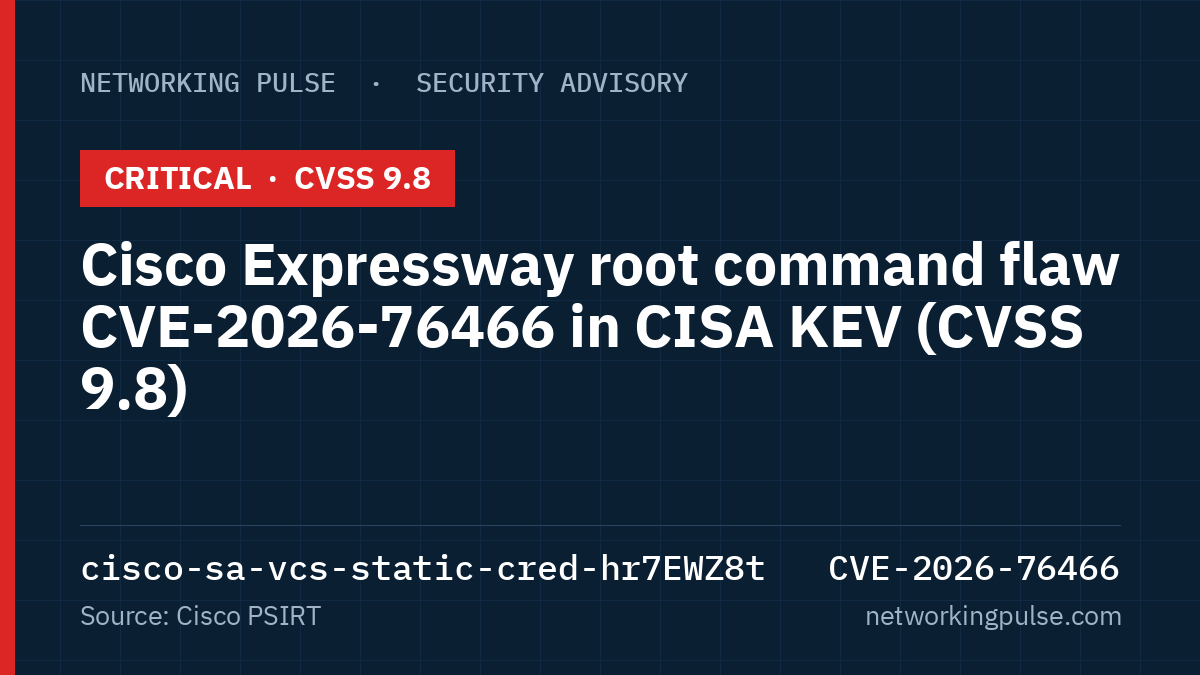
Cisco published security advisory cisco-sa-vcs-static-cred-hr7EWZ8t on 21 October 2026. It covers CVE-2026-76466, a flaw in the database service feature of Cisco Expressway Series. Cisco rates it Critical, with a CVSS 3.1 base score of 9.8. CISA added the CVE to its Known Exploited Vulnerabilities (KEV) catalog on 20 November 2026.
Advisory details
| Field | Value (as published by Cisco) |
|---|---|
| Advisory ID | cisco-sa-vcs-static-cred-hr7EWZ8t |
| Title | Cisco Expressway Series Remote Code Execution Vulnerability |
| First published | 2026 October 21 16:00 GMT |
| Version | 1.0 (Final) |
| Severity | Critical |
| CVE ID | CVE-2026-76466 |
| Cisco Bug ID | CSCww27732 |
| Weakness | CWE-798 |
| CVSS score | Base 9.8 |
| CVSS vector | CVSS:3.1/AV:N/AC:L/PR:N/UI:N/S:U/C:H/I:H/A:H/E:X/RL:X/RC:X |
| Workarounds | No workarounds available |
| Credit | Stefan Aleksic of Jane Street |
What the advisory says
Cisco's summary, quoted:
A vulnerability in the database service feature of Cisco Expressway Series could allow an unauthenticated, remote attacker with network access to a Cisco Expressway device to execute arbitrary operating system commands as root.
Cisco gives two causes. The service uses persistent cookies. It also does not validate client certificates when the TLS Verify Mode is set to Enabled for clustering. An attacker who holds the cookies can connect to the database service and invoke specific remote procedure call (RPC) commands. A successful attack runs commands as root on the underlying operating system.
Cisco Expressway Series means Cisco Expressway Core (Expressway-C) and Cisco Expressway Edge (Expressway-E) devices.
Affected products
The flaw affects Expressway-C and Expressway-E, both virtual and appliance versions. A device is affected only if it runs a vulnerable release and is configured in a cluster. Cisco states that only the products in its Vulnerable Products section are known to be affected.
Fixed releases
The table reproduces every row of Cisco's fixed-release table.
| Cisco Expressway Series Release | First Fixed Release |
|---|---|
| X14 and earlier | Migrate to a fixed release. |
| X15.5.3 and earlier | X15.5.20 |
Cisco notes that the fix is also part of its Cisco Expressway Series Security Hardening Release: October 2026. There are no workarounds. Cisco considers any workarounds and mitigations temporary until an upgrade to a fixed release is available.
Exploitation status
CISA lists CVE-2026-76466 in the KEV catalog as "Cisco Expressway Series Use of Hard-coded Credentials Vulnerability". It was added on 2026-11-20. CISA's due date is 2026-11-23. Known ransomware campaign use is listed as Unknown.
Cisco's advisory, version 1.0 of 21 October 2026, states that Cisco PSIRT is not aware of any public announcements or malicious use. That statement predates the KEV listing.
Terms explained
- Cisco Expressway Series: Cisco's Expressway Core (Expressway-C) and Expressway Edge (Expressway-E) devices, offered as virtual and appliance versions.
- Cluster: a group of Expressway devices configured to work together. Only clustered devices are affected.
- Persistent cookie: a session token that stays valid over time instead of expiring with each session.
- TLS Verify Mode: a clustering setting for TLS certificate checks. Cisco says client certificates are not validated when it is set to Enabled.
- RPC (remote procedure call): a way for one system to run a function on another over the network.
- CWE-798: the MITRE Common Weakness Enumeration entry for use of hard-coded credentials.
- CVSS vector: AV:N means the attack works over the network. AC:L means low attack complexity. PR:N means no privileges are needed. UI:N means no user interaction is needed. S:U means the scope is unchanged. C:H/I:H/A:H means high impact on confidentiality, integrity and availability. E:X/RL:X/RC:X are temporal metrics left undefined.
What This Means for IT Teams
The advisory concerns organisations that run Expressway-C or Expressway-E in a cluster, on virtual machines or appliances. Standalone devices fall outside Cisco's vulnerable-products definition. Confirm the installed release and the clustering configuration on each device.
The fix is release X15.5.20. Devices on X14 or earlier need a migration to a fixed release. Cisco lists no workaround, so the remediation in the advisory is the upgrade.
No user interaction or prior login is needed. The attacker needs network access to the device and possession of the cookies. CISA lists the flaw as known exploited, with a federal due date of 23 November 2026. Tracking this upgrade in vulnerability management keeps the cluster nodes in view until every node runs the fixed release.
NVD cross-check
The NVD record (status Analyzed, last modified 2026-11-20) matches Cisco on the description, the CVSS 3.1 score of 9.8 with the same base vector, and CWE-798. NVD lists no CVSS 4.0 score. NVD's affected data, supplied by Cisco, names the product "Cisco TelePresence Video Communication Server (VCS) Expressway" and lists releases from X8.1 through X15.5.3. NVD also records the CISA KEV addition on 2026-11-20 with a due date of 2026-11-23.
Related coverage: Cisco Secure Email Gateway SQL injection CVE-2026-76461 in CISA KEV.
Official sources: Cisco advisory cisco-sa-vcs-static-cred-hr7EWZ8t, NVD API record for CVE-2026-76466 and the CISA KEV JSON feed.