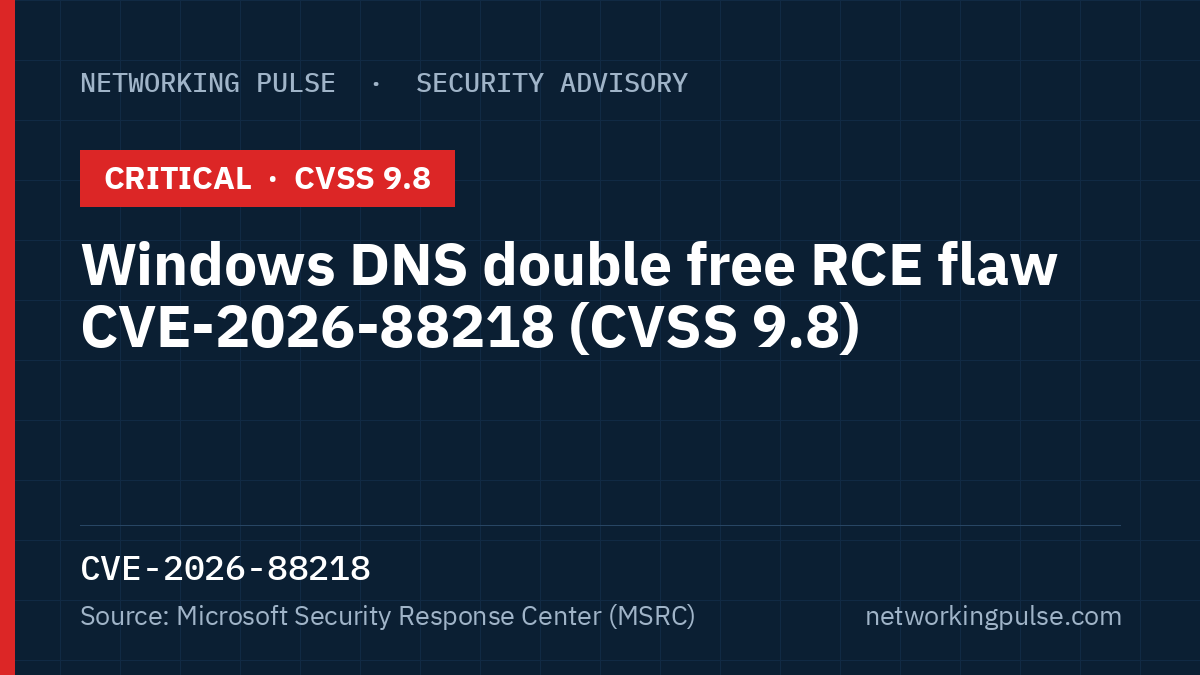
Microsoft published CVE-2026-88218, a Windows DNS remote code execution vulnerability, on 10 November 2026 as part of its November 2026 security updates. Microsoft rates it Important, with a CVSS 3.1 base score of 9.8. The flaw is a double free in Windows DNS. Microsoft lists security updates for 28 Windows 10, Windows 11 and Windows Server 2016 to 2025 products. Microsoft lists it as not publicly disclosed and not exploited, and it is not in the CISA KEV catalog.
Advisory details
| Field | Value (as published by Microsoft) |
|---|---|
| CVE ID | CVE-2026-88218 |
| Title | Windows DNS Remote Code Execution Vulnerability |
| Released | 2026-11-10 (release 2026-Nov) |
| Last revision | 2026-11-10, version 1: Information published. |
| Component tag | Windows DNS |
| Severity | Important |
| Impact | Remote Code Execution |
| CVSS 3.1 base / temporal score | 9.8 / 8.5 |
| CVSS 3.1 vector | CVSS:3.1/AV:N/AC:L/PR:N/UI:N/S:U/C:H/I:H/A:H/E:U/RL:O/RC:C |
| Weakness | CWE-415: Double Free |
| Publicly disclosed | No |
| Known attacks (per Microsoft) | None: Microsoft marks it not exploited |
| Exploitability assessment, latest software release | Less likely |
| Customer action required | Yes |
| Issuing CNA | Microsoft |
What the advisory says
Microsoft's description, quoted in full:
Double free in Windows DNS allows an unauthorized attacker to execute code over a network.
Microsoft's FAQ says that a successful attack could give remote code execution to an in-network attacker calling arbitrary endpoints. The CVSS vector shows that the attacker needs no privileges and no user interaction. Microsoft's advisory lists no mitigations or workarounds; the fix is the security update for each product.
Affected products and security updates
The tables below reproduce all 28 rows of Microsoft's security updates table for CVE-2026-88218, split into product groups. Every row has severity Important, impact Remote Code Execution, CVSS 3.1 base score 9.8 and customer action required. Where two updates are listed, the second is a Security Hotpatch Update.
Windows Server
| Product | Severity | Impact | Article | Download | Build number | Restart required |
|---|---|---|---|---|---|---|
| Windows Server 2016 | Important | Remote Code Execution | KB5131291 | Security Update | 10.0.14393.9688 | Yes |
| Windows Server 2016 (Server Core installation) | Important | Remote Code Execution | KB5131291 | Security Update | 10.0.14393.9688 | Yes |
| Windows Server 2019 | Important | Remote Code Execution | KB5131085 | Security Update | 10.0.17763.9487 | Yes |
| Windows Server 2019 (Server Core installation) | Important | Remote Code Execution | KB5131085 | Security Update | 10.0.17763.9487 | Yes |
| Windows Server 2022 | Important | Remote Code Execution | KB5131090 | Security Update | 10.0.20348.5870 | Yes |
| Windows Server 2022 (Server Core installation) | Important | Remote Code Execution | KB5131090 | Security Update | 10.0.20348.5870 | Yes |
| Windows Server 2025 | Important | Remote Code Execution | KB5131080 KB5131077 | Security Update Security Hotpatch Update | 10.0.26100.33822 10.0.26100.33730 | Yes No |
| Windows Server 2025 (Server Core installation) | Important | Remote Code Execution | KB5131080 KB5131077 | Security Update Security Hotpatch Update | 10.0.26100.33822 10.0.26100.33730 | Yes No |
Windows 11
| Product | Severity | Impact | Article | Download | Build number | Restart required |
|---|---|---|---|---|---|---|
| Windows 11 Version 23H2 for ARM64-based Systems | Important | Remote Code Execution | KB5131087 | Security Update | 10.0.22631.7711 | Yes |
| Windows 11 Version 23H2 for x64-based Systems | Important | Remote Code Execution | KB5131087 | Security Update | 10.0.22631.7711 | Yes |
| Windows 11 Version 24H2 for ARM64-based Systems | Important | Remote Code Execution | KB5132061 KB5132043 | Security Update Security Hotpatch Update | 10.0.26100.9974 10.0.26100.9911 | Yes No |
| Windows 11 Version 24H2 for x64-based Systems | Important | Remote Code Execution | KB5132061 KB5132043 | Security Update Security Hotpatch Update | 10.0.26100.9974 10.0.26100.9911 | Yes No |
| Windows 11 Version 25H2 for ARM64-based Systems | Important | Remote Code Execution | KB5132061 KB5132043 | Security Update Security Hotpatch Update | 10.0.26200.9974 10.0.26200.9911 | Yes No |
| Windows 11 Version 25H2 for x64-based Systems | Important | Remote Code Execution | KB5132061 KB5132043 | Security Update Security Hotpatch Update | 10.0.26200.9974 10.0.26200.9911 | Yes No |
| Windows 11 Version 26H1 for ARM64-based Systems | Important | Remote Code Execution | KB5132059 | Security Update | 10.0.28000.3501 | Yes |
| Windows 11 version 26H1 for x64-based Systems | Important | Remote Code Execution | KB5132059 | Security Update | 10.0.28000.3501 | Yes |
| Windows 11 Version 26H2 for ARM64-based Systems | Important | Remote Code Execution | KB5132061 KB5132043 | Security Update Security Hotpatch Update | 10.0.26300.9974 10.0.26300.9911 | Yes No |
| Windows 11 Version 26H2 for x64-based Systems | Important | Remote Code Execution | KB5132061 KB5132043 | Security Update Security Hotpatch Update | 10.0.26300.9974 10.0.26300.9911 | Yes No |
Windows 10
| Product | Severity | Impact | Article | Download | Build number | Restart required |
|---|---|---|---|---|---|---|
| Windows 10 Version 1607 for 32-bit Systems | Important | Remote Code Execution | KB5131291 | Security Update | 10.0.14393.9688 | Yes |
| Windows 10 Version 1607 for x64-based Systems | Important | Remote Code Execution | KB5131291 | Security Update | 10.0.14393.9688 | Yes |
| Windows 10 Version 1809 for 32-bit Systems | Important | Remote Code Execution | KB5131085 | Security Update | 10.0.17763.9487 | Yes |
| Windows 10 Version 1809 for x64-based Systems | Important | Remote Code Execution | KB5131085 | Security Update | 10.0.17763.9487 | Yes |
| Windows 10 Version 21H2 for 32-bit Systems | Important | Remote Code Execution | KB5131096 | Security Update | 10.0.19044.7846 | Yes |
| Windows 10 Version 21H2 for ARM64-based Systems | Important | Remote Code Execution | KB5131096 | Security Update | 10.0.19044.7846 | Yes |
| Windows 10 Version 21H2 for x64-based Systems | Important | Remote Code Execution | KB5131096 | Security Update | 10.0.19044.7846 | Yes |
| Windows 10 Version 22H2 for 32-bit Systems | Important | Remote Code Execution | KB5131096 | Security Update | 10.0.19045.7846 | Yes |
| Windows 10 Version 22H2 for ARM64-based Systems | Important | Remote Code Execution | KB5131096 | Security Update | 10.0.19045.7846 | Yes |
| Windows 10 Version 22H2 for x64-based Systems | Important | Remote Code Execution | KB5131096 | Security Update | 10.0.19045.7846 | Yes |
Known attacks and KEV status
Microsoft lists CVE-2026-88218 as not exploited and not publicly disclosed. Microsoft's exploitability assessment for the latest software release is "less likely". CVE-2026-88218 is not in the CISA KEV catalog (catalog version 2026.11.20). Absence from KEV does not prove that no attacks have taken place.
Terms explained
- Windows DNS: the Windows components that handle the Domain Name System, which translates host names into IP addresses. Microsoft tags this CVE "Windows DNS" and lists both Windows client and Windows Server releases.
- Double free (CWE-415): a memory bug where a program releases the same block of memory twice. This can corrupt memory and, in some cases, let an attacker run code.
- Remote code execution: an attacker can run their own commands on the target system over a network.
- Hotpatch: a Microsoft security update type that installs without a restart. In the table, hotpatch rows show "No" under restart required.
- CVSS vector AV:N/AC:L/PR:N/UI:N/S:U/C:H/I:H/A:H:
- AV:N (Attack Vector: Network): the attack works over the network.
- AC:L (Attack Complexity: Low): no special conditions are needed.
- PR:N (Privileges Required: None): the attacker needs no account.
- UI:N (User Interaction: None): no user has to do anything.
- S:U (Scope: Unchanged): the impact stays within the vulnerable component.
- C:H, I:H, A:H: high impact on confidentiality, integrity and availability.
- Temporal metrics E:U/RL:O/RC:C: E:U means no exploit code is known (Unproven); RL:O means an official fix exists; RC:C means the report is confirmed. These lower the score from 9.8 to a temporal 8.5.
What This Means for IT Teams
Microsoft lists Windows 10 (1607, 1809, 21H2, 22H2), Windows 11 (23H2, 24H2, 25H2, 26H1, 26H2) and Windows Server 2016, 2019, 2022 and 2025, including Server Core installations. Microsoft's table is not limited to servers that run the DNS Server role.
To confirm exposure, compare each system's OS build number with the build number in the tables. The standard security updates require a restart. Windows Server 2025 and Windows 11 24H2, 25H2 and 26H2 also have a hotpatch option that does not. Microsoft lists no workaround, so installing the update is the remediation.
The attack needs network access only, with no login and no user action. Microsoft lists it as not exploited and not publicly disclosed, and CISA has not added it to KEV. Patch management teams can roll this update out with the November 2026 cycle and use the build numbers above to confirm coverage on every endpoint and server.
NVD cross-check
- Agrees: NVD (status Analyzed, published 2026-11-10) shows the same description, CWE-415 and the CVSS 3.1 base vector with score 9.8, supplied by Microsoft as a Secondary score. NVD lists no CVSS 4.0 score.
- Differs: NVD shows the CVSS 3.1 base severity as Critical, the standard label for a 9.8 score. Microsoft's own severity rating is Important. Microsoft's vector also adds temporal metrics (temporal score 8.5), which NVD does not show.
- Agrees: NVD lists no CISA KEV entry for this CVE, matching the CISA feed.
Related coverage: Windows NTLM spoofing flaw CVE-2026-121680 can leak NTLMv2 hashes.