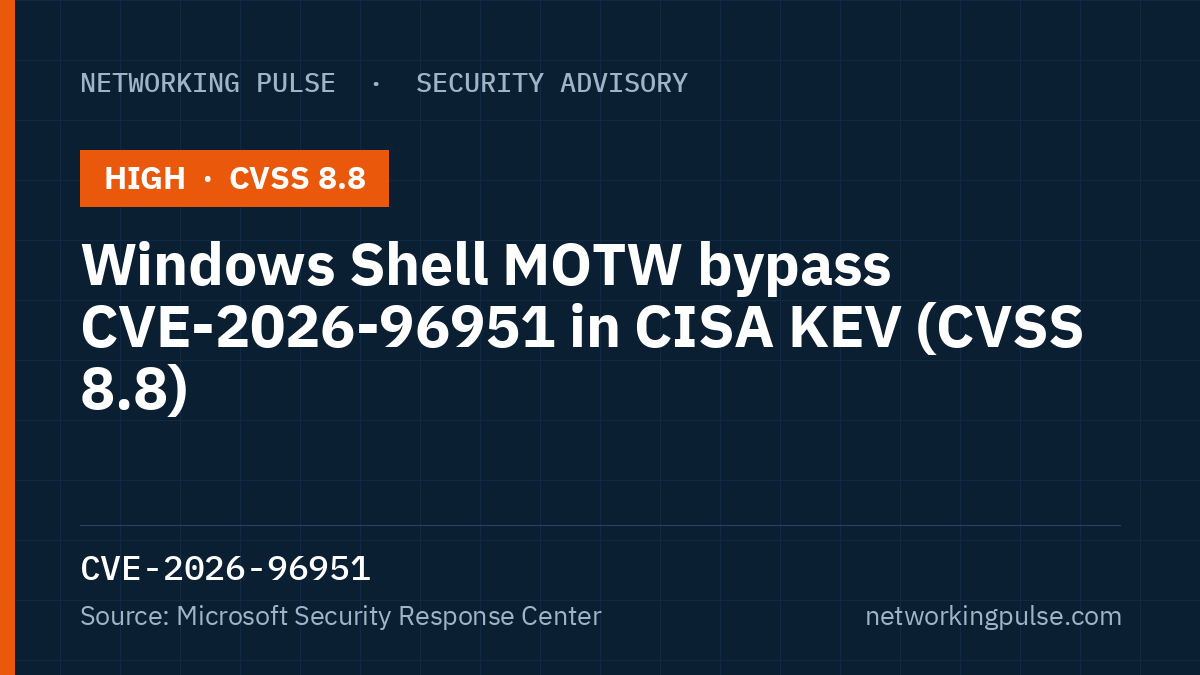
Microsoft fixed CVE-2026-96951, a security feature bypass in Windows Shell, in its October 2026 security updates. Microsoft rates it Important with a CVSS 3.1 base score of 8.8 and marks it "Exploitation Detected". CISA added it to its KEV catalog on 2026-10-13.
Advisory details
- Title: Windows Shell Security Feature Bypass Vulnerability.
- Released: 2026-10-13 (2026-Oct release). Latest revision: 2026-10-26.
- CNA: Microsoft.
- Severity: Important. Impact: Security Feature Bypass.
- CVSS 3.1: base 8.8, temporal 8.2.
- Vector: CVSS:3.1/AV:N/AC:L/PR:N/UI:R/S:U/C:H/I:H/A:H/E:F/RL:O/RC:C.
- Weakness: CWE-77, Improper Neutralization of Special Elements used in a Command ('Command Injection').
- Publicly disclosed: No. Exploited: Yes.
- Customer action required: Yes.
What the flaw does
Microsoft describes the flaw as improper neutralization of special elements used in a command in Windows Shell. It lets an unauthorized attacker bypass a security feature over a network.
According to Microsoft's FAQ, the bypassed feature is Mark of the Web (MOTW). An attacker could send a specially crafted file by email or instant message. The attacker cannot force a user to view the content. The user must be persuaded to click a link or open an attachment.
Revision history
- Version 1 (2026-10-13): information published.
- Version 2 (2026-10-26): Microsoft added Edge to the Security Updates table. Customers on a supported Edge version should update to the listed version.
Security updates
Microsoft lists 32 affected products. Every row is reproduced below, grouped by product family. Microsoft's data places Windows 10 22H2 and 1607, Windows Server 2016 and Windows Server 2012 R2 in its Extended Security Updates (ESU) product family.
Microsoft Edge and Outlook.com (2 rows)
| Product | Article | Update type | Fixed build | Restart required |
|---|---|---|---|---|
| Microsoft Edge (Chromium-based) | Release Notes | Security Update | 154.0.4258.62 | Not stated |
| Outlook.com | Release Notes | Security Update | 20260925.100 | Yes |
Windows 11 (10 rows)
| Product | Article | Update type | Fixed build | Restart required |
|---|---|---|---|---|
| Windows 11 Version 23H2 for ARM64-based Systems | KB5126653 | Security Update | 10.0.22631.7652 | Yes |
| Windows 11 Version 23H2 for x64-based Systems | KB5126653 | Security Update | 10.0.22631.7652 | Yes |
| Windows 11 Version 24H2 for ARM64-based Systems | KB5127648 | Security Update | 10.0.26100.9711 | Yes |
| Windows 11 Version 24H2 for x64-based Systems | KB5127648 | Security Update | 10.0.26100.9711 | Yes |
| Windows 11 Version 25H2 for ARM64-based Systems | KB5127648 | Security Update | 10.0.26200.9711 | Yes |
| Windows 11 Version 25H2 for x64-based Systems | KB5127648 | Security Update | 10.0.26200.9711 | Yes |
| Windows 11 Version 26H1 for ARM64-based Systems | KB5127646 | Security Update | 10.0.28000.3231 | Yes |
| Windows 11 version 26H1 for x64-based Systems | KB5127646 | Security Update | 10.0.28000.3231 | Yes |
| Windows 11 Version 26H2 for ARM64-based Systems | KB5127648 | Security Update | 10.0.26300.9711 | Yes |
| Windows 11 Version 26H2 for x64-based Systems | KB5127648 | Security Update | 10.0.26300.9711 | Yes |
Windows 10 (10 rows)
| Product | Article | Update type | Fixed build | Restart required |
|---|---|---|---|---|
| Windows 10 Version 1607 for 32-bit Systems | KB5126868 | Security Update | 10.0.14393.9612 | Yes |
| Windows 10 Version 1607 for x64-based Systems | KB5126868 | Security Update | 10.0.14393.9612 | Yes |
| Windows 10 Version 1809 for 32-bit Systems | KB5126651 | Security Update | 10.0.17763.9376 | Yes |
| Windows 10 Version 1809 for x64-based Systems | KB5126651 | Security Update | 10.0.17763.9376 | Yes |
| Windows 10 Version 21H2 for 32-bit Systems | KB5126657 | Security Update | 10.0.19044.7807 | Yes |
| Windows 10 Version 21H2 for ARM64-based Systems | KB5126657 | Security Update | 10.0.19044.7807 | Yes |
| Windows 10 Version 21H2 for x64-based Systems | KB5126657 | Security Update | 10.0.19044.7807 | Yes |
| Windows 10 Version 22H2 for 32-bit Systems | KB5126657 | Security Update | 10.0.19045.7807 | Yes |
| Windows 10 Version 22H2 for ARM64-based Systems | KB5126657 | Security Update | 10.0.19045.7807 | Yes |
| Windows 10 Version 22H2 for x64-based Systems | KB5126657 | Security Update | 10.0.19045.7807 | Yes |
Windows Server (10 rows)
| Product | Article | Update type | Fixed build | Restart required |
|---|---|---|---|---|
| Windows Server 2012 R2 | KB5126836 | Monthly Rollup | 6.3.9600.23470 | Yes |
| Windows Server 2012 R2 (Server Core installation) | KB5126836 | Monthly Rollup | 6.3.9600.23470 | Yes |
| Windows Server 2016 | KB5126868 | Security Update | 10.0.14393.9612 | Yes |
| Windows Server 2016 (Server Core installation) | KB5126868 | Security Update | 10.0.14393.9612 | Yes |
| Windows Server 2019 | KB5126651 | Security Update | 10.0.17763.9376 | Yes |
| Windows Server 2019 (Server Core installation) | KB5126651 | Security Update | 10.0.17763.9376 | Yes |
| Windows Server 2022 | KB5126655 | Security Update | 10.0.20348.5761 | Yes |
| Windows Server 2022 (Server Core installation) | KB5126655 | Security Update | 10.0.20348.5761 | Yes |
| Windows Server 2025 | KB5126646 | Security Update | 10.0.26100.33650 | Yes |
| Windows Server 2025 (Server Core installation) | KB5126646 | Security Update | 10.0.26100.33650 | Yes |
Exploitation status
Microsoft marks CVE-2026-96951 as exploited ("Exploitation Detected"). CISA lists it in the KEV catalog as "Microsoft Windows Command Injection Vulnerability". CISA added it on 2026-10-13 with a due date of 2026-10-16 for federal agencies. Known ransomware campaign use is "Unknown", and forensic triage is "Yes".
Terms explained
- Windows Shell: the Windows component that provides the desktop, File Explorer and file handling.
- Mark of the Web (MOTW): a tag Windows adds to files from the internet. It triggers extra warnings and protections when such files are opened.
- Security feature bypass: the flaw does not run code by itself. It switches off or avoids a protection that would otherwise apply.
- CWE-77 (command injection): input is not cleaned of special characters before it becomes part of a command.
- AV:N, AC:L, PR:N: the attack works over the network, with low complexity and no privileges.
- UI:R: a user must take an action, such as opening a file.
- S:U: scope unchanged. C:H, I:H, A:H: high impact on confidentiality, integrity and availability.
- E:F, RL:O, RC:C: functional exploit code exists, an official fix is available and the report is confirmed. These lower the temporal score to 8.2.
- KEV and BOD 26-04: CISA's catalog of flaws with evidence of real attacks, and the directive that sets remediation deadlines for US federal agencies.
What This Means for IT Teams
Every Windows client and server release in the table is in scope, from Windows Server 2012 R2 to Windows 11 26H2. Microsoft Edge is also listed with fixed version 154.0.4258.62.
Confirm that each device runs at least the fixed build listed for its release, from the October 2026 updates. Microsoft lists a restart as required for the Windows updates. Microsoft lists Windows 10 22H2 and Server 2016, among others, under its ESU family. This is routine work for patch management, with Edge updates tracked alongside.
A successful attack needs a user to open a crafted file or link. The flaw is KEV-listed and Microsoft reports it as exploited, so devices still missing the October updates deserve attention first.
NVD cross-check
- Agrees: the description, CWE-77 and the CVSS 3.1 base score of 8.8 with the same base vector, provided by Microsoft ([email protected]).
- Score version: NVD lists no CVSS 4.0 score and does not show Microsoft's temporal score.
- Status: Analyzed, published 2026-10-13, last modified 2026-10-29.
Related coverage: Windows NTLM spoofing flaw CVE-2026-121680 can leak NTLMv2 hashes.