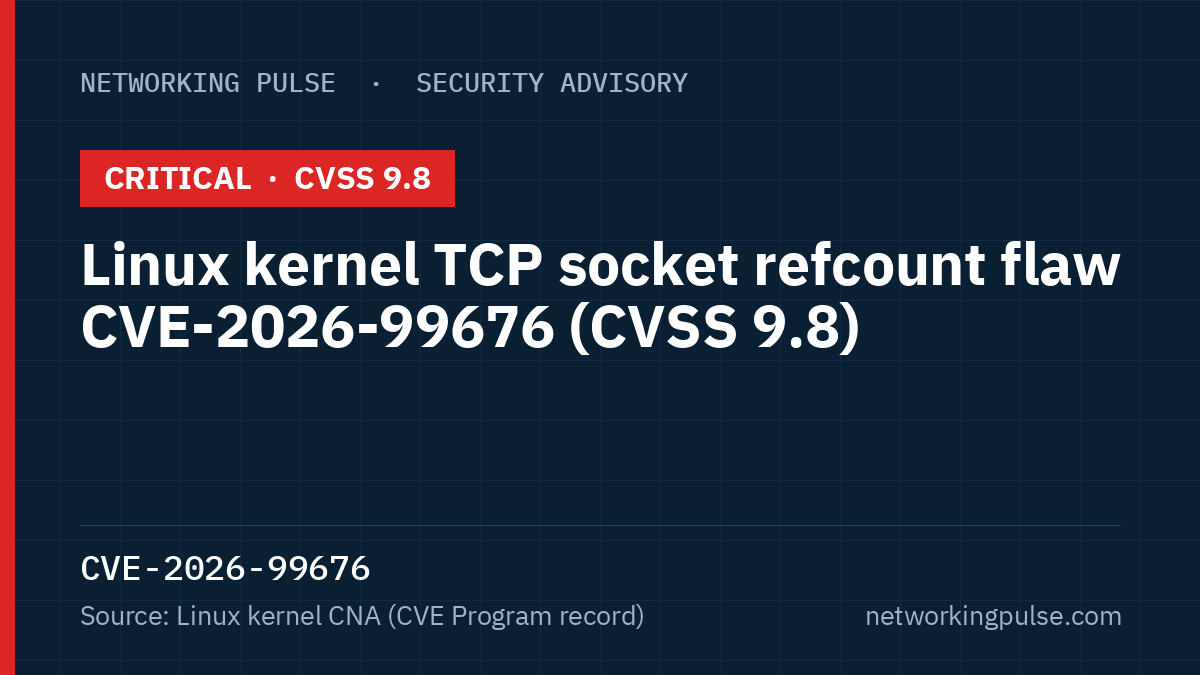
The Linux kernel CVE Numbering Authority (CNA) published CVE-2026-99676 on 2026-11-20. The record is titled "net: restore refcount ordering for lockless socket access". It rates the flaw CVSS 3.1 9.8 (Critical). The flaw is a missing memory-ordering guarantee in the kernel's IPv4 and IPv6 TCP socket lookups. Updated stable kernels 6.12.118, 6.18.64 and 7.3.5 fix it, and mainline is fixed from 7.4-rc2.
Advisory details
- CVE: CVE-2026-99676 (the only CVE in this record)
- Assigner: Linux (the Linux kernel CNA)
- Published: 2026-11-20; last updated 2026-11-22
- Product: Linux kernel
- CVSS: 3.1 base score 9.8 (Critical), vector CVSS:3.1/AV:N/AC:L/PR:N/UI:N/S:U/C:H/I:H/A:H, assigned by the Linux CNA
- CWE: none listed in the record
- Exploitation status: Not known to be exploited. The CVE is not listed in the CISA Known Exploited Vulnerabilities (KEV) catalog, version 2026.11.20.
- Workarounds: none listed in the record
What the flaw is
The record explains the cause. Commit fb041bb7c0a9 ("locking/refcount: Consolidate implementations of refcount_t") changed how refcount_inc_not_zero() works. Before it, default builds gave full memory ordering on success. After it, weakly ordered architectures lost that ordering. Memory accesses made after taking a socket reference could then be reordered before it.
The fix uses refcount_inc_not_zero_acquire() in the IPv4 and IPv6 established-connection lookups and in inet_twsk_purge(). bpf_sk_assign() also uses acquire ordering when it takes its own reference. The SYN cookie, TCP Fast Open, request migration and TIME_WAIT paths now use refcount_set_release().
The CNA's CVSS scenario describes the effects. An attacker opens and closes connections and completes SYN-cookie handshakes while sending more TCP segments. A segment can then reach a recycled socket. The kernel may read and release a freed route entry (dst_entry). It may also update the recycled socket's sequence state and receive queue. A NULL pointer read in softirq context can crash (oops) the host.
The changed files are net/core/filter.c, net/ipv4/inet_connection_sock.c, net/ipv4/inet_hashtables.c, net/ipv4/inet_timewait_sock.c, net/ipv4/syncookies.c, net/ipv4/tcp_fastopen.c and net/ipv6/inet6_hashtables.c.
Affected and fixed versions
This table reproduces every version entry in the Linux CNA record.
| Kernel version or range | Status in the record |
|---|---|
| Earlier than 5.5 | Unaffected (except the 5.4 range below) |
| 5.4.208 up to, but not including, 5.5 | Affected (the record also lists git commit d0d583484d2e as affected); no fixed 5.4 version is listed |
| 5.5 and later | Affected, unless at or above a fixed version below |
| 6.12.118 and later 6.12.x | Unaffected (fixed) |
| 6.18.64 and later 6.18.x | Unaffected (fixed) |
| 7.3.5 and later 7.3.x | Unaffected (fixed) |
| 7.4-rc2 and later | Unaffected (original mainline fix) |
The record lists four fix commits in the stable tree: 6f4fc93f76cd, ddd14d0b5b5e, 52f5a5ab318f and 5b5d8f351dd9. The issue was introduced by commit fb041bb7c0a9.
Terms explained
- Reference count (refcount): a counter that tracks how many users hold an object. The object is freed when it reaches zero.
- Memory ordering: rules for the order in which a CPU makes memory reads and writes visible. On weakly ordered architectures, the CPU may reorder them unless the code asks for ordering.
- Acquire and release ordering: an acquire stops later accesses from moving before it. A release stops earlier accesses from moving after it.
- Lockless socket access: the kernel finds sockets without taking a lock. It then checks the socket again after taking a reference.
- SYN cookie: a TCP technique that encodes connection state in the handshake. It is used when the queue of half-open connections is full.
- TCP Fast Open: a TCP extension that lets data travel in the first handshake packet.
- TIME_WAIT: the state a TCP connection stays in for a while after it closes.
- bpf_sk_assign(): a BPF helper that assigns a socket to a packet.
- dst_entry: the kernel's cached route information for a socket.
- Use after free: code keeps using memory after it has been freed.
- AV:N (Attack Vector: Network): an attacker can reach the flaw over the network.
- AC:L (Attack Complexity: Low): no special conditions outside the attacker's control are needed.
- PR:N (Privileges Required: None): the attacker needs no account.
- UI:N (User Interaction: None): no user action is needed.
- S:U (Scope: Unchanged): the impact stays within the host kernel.
- C:H, I:H, A:H: high impact on confidentiality, integrity and availability.
What This Means for IT Teams
Systems that run an upstream Linux kernel from 5.5 onward, or a 5.4 kernel from 5.4.208, fall within the affected ranges. The affected code is in the IPv4 and IPv6 TCP receive paths. The record's scenario needs no account and no user action.
Compare each system's running kernel version with the table. Move to 6.12.118, 6.18.64, 7.3.5 or a later release on the same branch, or to 7.4-rc2 or later. The record lists no fixed 5.4 release and no workaround.
The flaw is not in the CISA KEV catalog. Tracking kernel versions across servers is a routine part of vulnerability management and patch management.
NVD cross-check
The NVD record has the status "Received". NVD shows the same description, affected data and CVSS 3.1 score of 9.8 with the same vector. That score comes from the Linux CNA as a secondary source. NVD has not added its own score, CWE or CPE data. No difference from the CNA record was found.