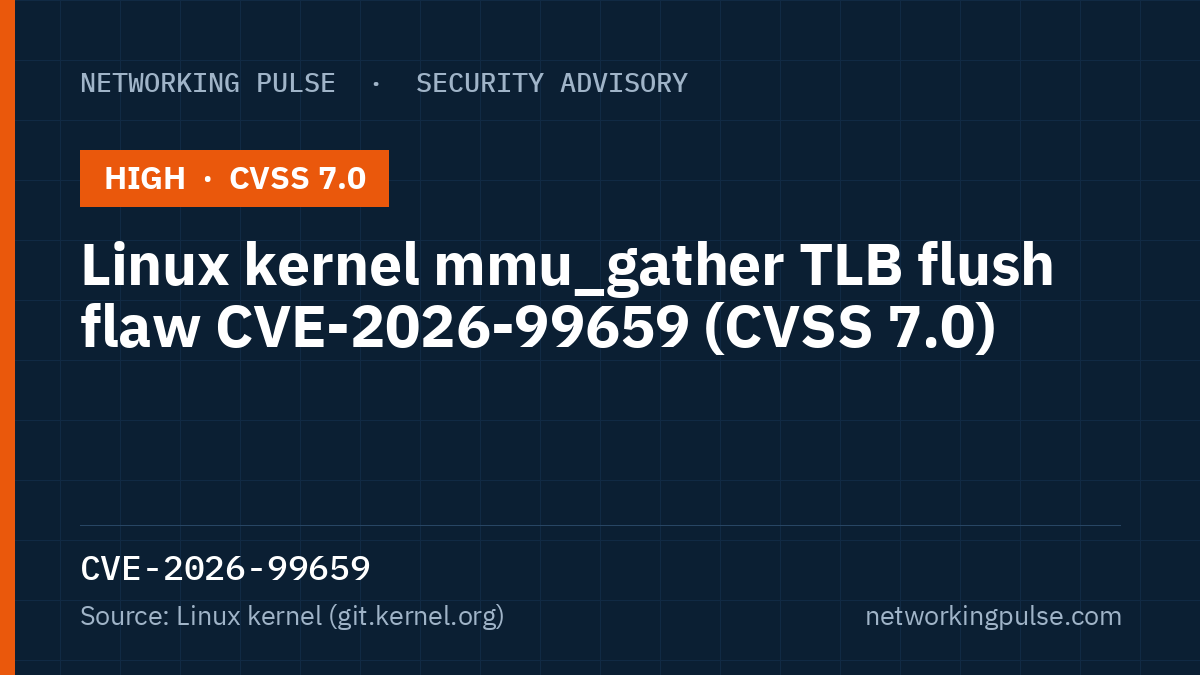
The Linux kernel CVE Numbering Authority (CNA) published CVE-2026-99659 on 2026-11-20. The flaw is in the memory-management TLB flush helper in include/asm-generic/tlb.h. A flush range of 4 GiB or larger is truncated, possibly to 0. The CNA rates it CVSS 3.1 7.0 (High). It is not listed in the CISA Known Exploited Vulnerabilities (KEV) catalog.
Advisory at a glance
| Field | Value |
|---|---|
| CVE | CVE-2026-99659 |
| Title | mm/mmu_gather: fix flushing ranges with 4 GiB or larger |
| Assigner | Linux (kernel CNA) |
| Published / updated | 2026-11-20 / 2026-11-23 (CVE record) |
| Affected file | include/asm-generic/tlb.h |
| CVSS | CVSS 3.1 base score 7.0 (High), vector CVSS:3.1/AV:L/AC:H/PR:L/UI:N/S:U/C:H/I:H/A:H |
| Introduced by | Commit b528e4b6405b ("mm/hugetlb: add tlb_remove_hugetlb_entry for handling hugetlb pages"); the fix also names commit 8ce720d5bd91 |
| Fix author | Josef Bacik. The commit states the fix was generated by an LLM and sent by Josef Bacik in private. |
| CISA KEV | Not listed (feed version 2026.11.25). Not known to be exploited: the CVE record states no exploitation status. |
What the vulnerability is
__tlb_adjust_range() takes the size of the range to flush as an unsigned int. Its callers, tlb_flush_{pte,pmd,pud,p4d}_range(), pass an unsigned long. A range of 4 GiB or larger is therefore truncated, possibly to 0.
The fix commit names at least two affected scenarios, both on arm64 with hugetlb:
- A kernel with 64K pages can map 16 GiB hugetlb folios contiguously at the PMD level and flush them when unmapping.
- A kernel with 16K pages can flush 64 GiB PUDs through
tlb_unshare_pmd_ptdesc().
The CNA explains the result. arm64 tlb_flush() computes zero pages to flush and skips the range. The folio is then freed while a stale TLB entry still maps it. The old virtual address can still read and write the physical page after the pool hands it to a new owner.
Attack conditions in the CNA's CVSS scoring
- AV:L (local): the bug is reached by
munmap()of a hugetlb mapping. No remote protocol supplies the size. - AC:H (high complexity): the truncation fires only for a single range of at least 4 GiB. Those folios exist only if root filled
nr_hugepagesorhugetlb_cma. The attacker cannot create them. - PR:L (low privileges):
MAP_HUGETLBneeds no capability check. A local user who can already allocate from the huge page pool can trigger the path. - UI:N (no user interaction): the attacker faults in their own mapping and calls
munmap(). No other user has to act. - S:U (scope unchanged): the stale translation stays in the unmapping process's address space.
- C:H and I:H: reads and writes through the old address reach memory that another hugetlb allocation now owns.
- A:H: this use-after-free of the folio can crash whoever next receives the page.
Affected versions and fixes
| Kernel versions | Status | Fixed in |
|---|---|---|
| Before 4.10 | Not affected | Not applicable |
| 4.10 and later | Affected | See the rows below |
| 5.10 series | Affected before 5.10.275 | 5.10.275 |
| 5.15 series | Affected before 5.15.226 | 5.15.226 |
| 6.1 series | Affected before 6.1.193 | 6.1.193 |
| 6.6 series | Affected before 6.6.163 | 6.6.163 |
| 6.12 series | Affected before 6.12.118 | 6.12.118 |
| 6.18 series | Affected before 6.18.64 | 6.18.64 |
| 7.3 series | Affected before 7.3.5 | 7.3.5 |
| Mainline | Affected before 7.4-rc2 | 7.4-rc2 |
The CVE record lists no fixed version for other series from 4.10 onward. It lists eight fix commits: mainline 64ae7959a1df and its stable backports b0f998ce242e, b263e5ef0456, 1fe9a6e2f1d0, 28aa2e9f4ab6, da895690b531, 2e12a0d8fa2e, 3647c49f1640.
The fix declares range_size as unsigned long, so the full range is flushed. The CVE record lists no workaround.
Terms explained
- TLB (Translation Lookaside Buffer): a CPU cache of virtual-to-physical address translations. After memory is unmapped, its TLB entries must be flushed.
- mmu_gather: the kernel mechanism that batches page unmaps and the TLB flushes they need.
- hugetlb: the kernel's support for large, pre-reserved memory pages (huge pages).
- Folio: the kernel's unit for managing one or more contiguous memory pages.
- PMD / PUD: upper levels of the page table. One entry at these levels can map a very large block of memory.
- Integer truncation: storing a value in a smaller type loses its high bits. Here 4 GiB or more does not fit in 32 bits.
- Use-after-free: memory is used after it has been released and possibly reused.
- CVSS 3.1 vector: AV:L local attack vector; AC:H high attack complexity; PR:L low privileges; UI:N no user interaction; S:U scope unchanged; C:H/I:H/A:H high impact on confidentiality, integrity and availability.
What This Means for IT Teams
The fix commit names arm64 systems with hugetlb as the affected scenarios: kernels with 64K pages using 16 GiB huge pages, and kernels with 16K pages flushing 64 GiB PUDs. Per the CNA, the condition also needs a root-configured huge page pool (nr_hugepages or hugetlb_cma).
An attacker needs local access and the ability to allocate from that pool. No user interaction is needed. The CVE is not in the CISA KEV catalog.
On arm64 hosts, check the running kernel version, the kernel page size and whether huge page pools are configured. Update to a fixed release from the table above. Where the affected hosts are servers, schedule the kernel update with routine server infrastructure maintenance.
NVD cross-check
- NVD status: Received. Published 2026-11-20, last modified 2026-11-23.
- NVD shows the CNA's CVSS 3.1 score 7.0 (High), vector CVSS:3.1/AV:L/AC:H/PR:L/UI:N/S:U/C:H/I:H/A:H. NVD has not added its own score yet.
- NVD lists no CWE and no CPE configuration yet.
- NVD's description and its eight reference commits match the CVE record. No discrepancy found.
Related coverage: Linux kernel huge page truncate race CVE-2026-99669 (CVSS 7.8).