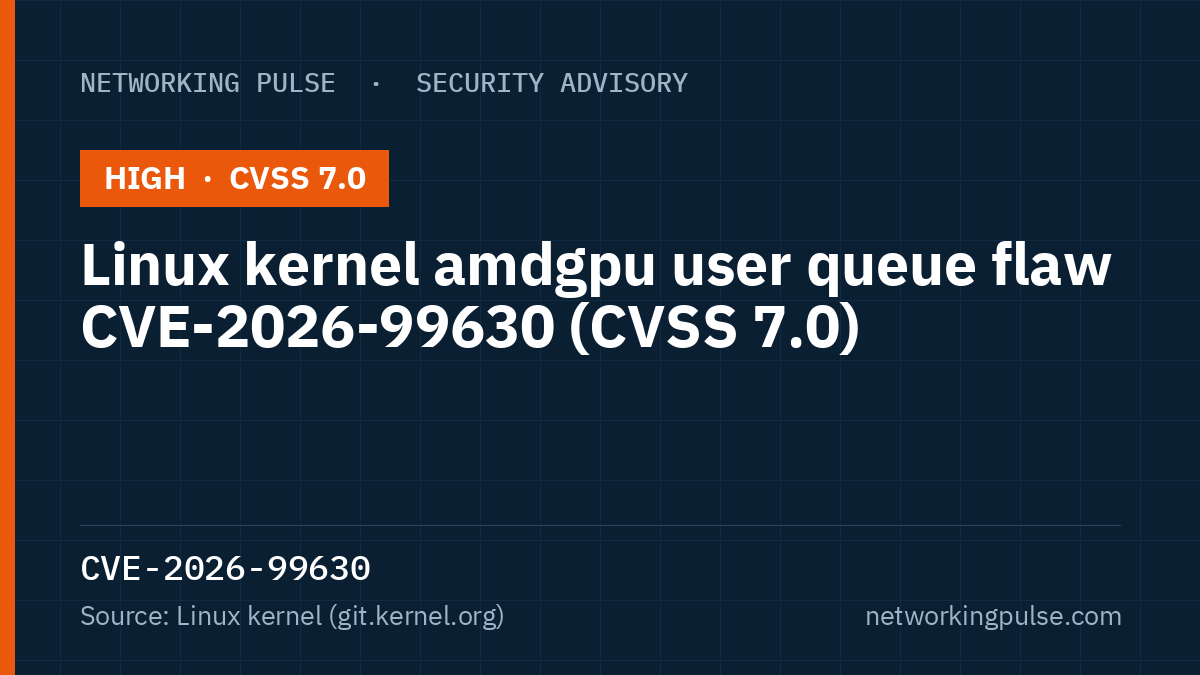
The Linux kernel CVE Numbering Authority (CNA) published CVE-2026-99630 on 2026-11-20. The flaw is in the AMD GPU driver's user queue code, drivers/gpu/drm/amd/amdgpu/amdgpu_userq.c. The CNA rates it CVSS 3.1 7.0 (High). It is not listed in the CISA Known Exploited Vulnerabilities (KEV) catalog.
Advisory at a glance
| Field | Value |
|---|---|
| CVE | CVE-2026-99630 |
| Title | drm/amdgpu/userq: validate the moved individual BOs on restore |
| Assigner | Linux (kernel CNA) |
| Published / updated | 2026-11-20 / 2026-11-22 (CVE record) |
| Affected file | drivers/gpu/drm/amd/amdgpu/amdgpu_userq.c |
| CVSS | CVSS 3.1 base score 7.0 (High), vector CVSS:3.1/AV:L/AC:H/PR:L/UI:N/S:U/C:H/I:H/A:H |
| Introduced by | Commit 4cdbba5a16aa ("drm/amdgpu: restructure VM state machine v4"); the fix also names commit 18decfc9e8cc ("drm/amdgpu/userq: actually validate userq BOs") |
| Fix author | Jesse Zhang (AMD); reviewed by Christian König |
| CISA KEV | Not listed (feed version 2026.11.25). Not known to be exploited: the CVE record states no exploitation status. |
What the vulnerability is
A user queue lets a process submit GPU work directly. Its virtual memory (VM) holds buffer objects (BOs). An "individual" BO does not share the VM's root reservation.
When such a BO is evicted, it goes to the individual needs_update list. The restore code looked at a different list, which only holds imported DMA-bufs of compute VMs. So for a user queue VM, nothing was validated.
The restore then neither locked the BO nor moved it back. Its page table entries (PTEs) were updated to wherever it was. They were cleared if it went to system memory. The BO also missed the new eviction fence, so it could move again under the running queue.
The fix commit says that on navi48 hardware, once the BOs of an SDMA user queue are evicted from GTT, the queue faults on its ring and read pointer (rptr).
Attack conditions in the CNA's CVSS scoring
- AV:L (local): the attacker is a local process. It creates the queue through the
DRM_IOCTL_AMDGPU_USERQioctl. - AC:H (high complexity): the code is reachable only when usermode queues are enabled. With the default
amdgpu.user_queue=-1,gfx_v12_0_early_initandsdma_v7_0_early_initdisable them. An administrator must set the parameter to 1 or 2. The attacker cannot create that state. - PR:L (low privileges): the ioctl allows a render-node client without
CAP_SYS_ADMIN. An unprivileged local user who can open the render node can create the queue. - UI:N (no user interaction): the attacker creates the queue and forces the eviction. No other user has to act.
- S:U (scope unchanged): the corrupted mapping is a GPU page table entry in the caller's own VM. Impact stays in the host kernel that owns the GPU.
- C:H and I:H: the unfenced BO can move while its PTE stays valid and writable. The running queue can then read from, or write to, a recycled page.
- A:H: a BO left in system memory loses its valid PTE flag, and the restored queue faults.
Affected versions and fixes
| Kernel versions | Status | Fixed in |
|---|---|---|
| Before 7.2 | Not affected | Not applicable |
| 7.2 and later | Affected | See the rows below |
| 7.3 series | Affected before 7.3.5 | 7.3.5 |
| Mainline | Affected before 7.4-rc2 | 7.4-rc2 |
The CVE record lists no fixed version for the 7.2 series. It lists two fix commits: 2664f497d5e3 (stable, 7.3.5) and ce5f2a25bdf6 (mainline, 7.4-rc2).
The fix validates the BOs on the individual needs_update list, as the code did before. The CVE record lists no workaround.
Terms explained
- amdgpu: the Linux kernel driver for AMD graphics hardware.
- User queue (userq): a GPU command queue that a user process manages directly.
- Buffer object (BO): a block of memory the GPU driver manages for a process.
- Eviction: the memory manager (TTM) moves a BO out of its current location, for example out of GTT to system memory.
- GTT: the Graphics Translation Table, system memory the GPU can access.
- PTE: a page table entry, which maps a GPU virtual address to a physical page.
- Eviction fence: a signal that blocks a BO from moving while a queue still uses it.
- Render node: the device file that lets non-privileged processes use the GPU.
- CVSS 3.1 vector: AV:L local attack vector; AC:H high attack complexity; PR:L low privileges; UI:N no user interaction; S:U scope unchanged; C:H/I:H/A:H high impact on confidentiality, integrity and availability.
What This Means for IT Teams
Only systems running kernel 7.2 or later with the amdgpu driver are in scope. The vulnerable code is reachable only when an administrator has enabled usermode queues through the amdgpu.user_queue parameter (value 1 or 2). With the default value of -1, the CNA says the gfx_v12_0 and sdma_v7_0 init code disables them.
An attacker needs local access and the ability to open the GPU render node. No user interaction is needed. The CVE is not in the CISA KEV catalog.
Check the running kernel version and the amdgpu.user_queue setting on hosts with AMD GPUs. Move 7.3 systems to 7.3.5 or later. The CVE record lists no fix for the 7.2 series and no workaround. Folding these hosts into routine patch management keeps kernel updates on schedule.
NVD cross-check
- NVD status: Received. Published 2026-11-20, last modified 2026-11-22.
- NVD shows the CNA's CVSS 3.1 score 7.0 (High), vector CVSS:3.1/AV:L/AC:H/PR:L/UI:N/S:U/C:H/I:H/A:H. NVD has not added its own score yet.
- NVD lists no CWE and no CPE configuration yet.
- NVD's description and its two reference commits match the CVE record. No discrepancy found.
Related coverage: Linux kernel mmu_notifier radeon flaw CVE-2026-99657 (CVSS 7.8).