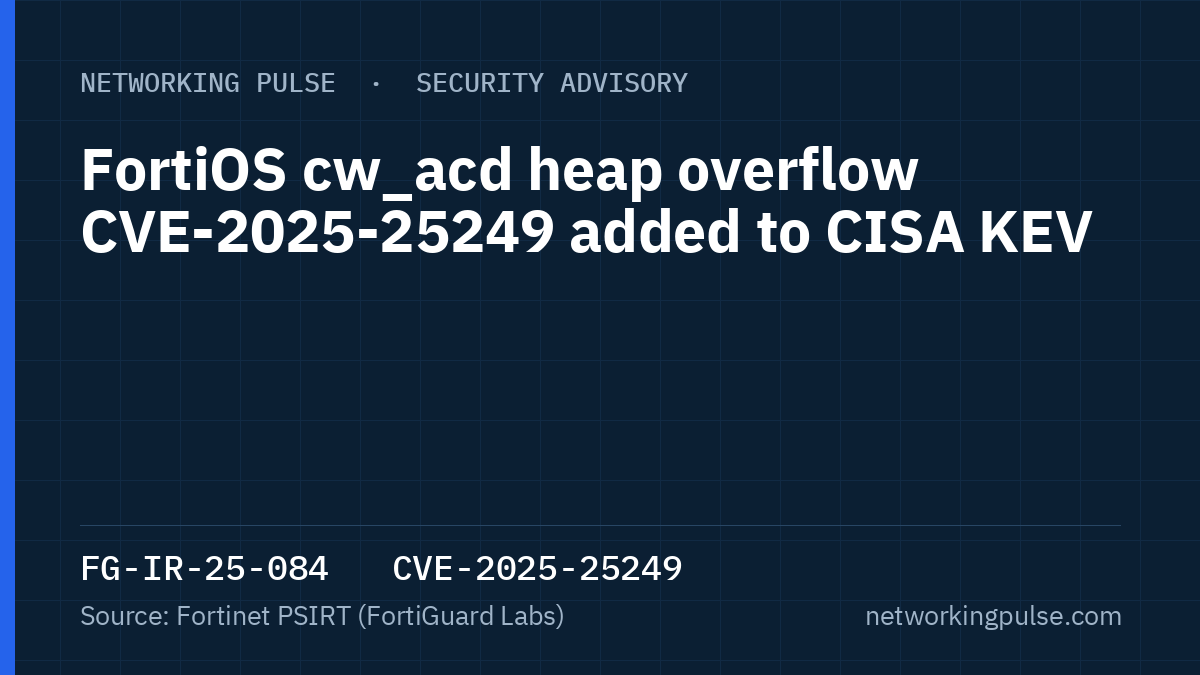
Fortinet has fixed CVE-2025-25249, a heap-based buffer overflow in the cw_acd daemon of FortiOS and FortiSwitchManager. Fortinet rates it High with a CVSS 3.1 base score of 8.1; NVD's own assessment is 9.8 Critical. CISA added it to its Known Exploited Vulnerabilities (KEV) catalog on 2026-09-09.
Advisory details
- Title: Heap-based buffer overflow in cw_acd daemon.
- IR number: FG-IR-25-084. CVE: CVE-2025-25249.
- Published: 2026-01-13. Updated: 2026-02-23.
- Severity: High. CVSSv3 score: 8.1. CVSSv3 temporal score: 7.4.
- Component: OTHERS. Attack type: Unauthenticated. Discovered: Internal.
- Impact: Execute unauthorized code or commands.
- Known exploited (Fortinet field): No.
- Summary: A heap-based buffer overflow (CWE-122) in the FortiOS and FortiSwitchManager cw_acd daemon may allow a remote unauthenticated attacker to execute arbitrary code or commands via specially crafted requests.
- Fortinet's note: security controls such as ASLR and PIE considerably raise the complexity and preparation effort a successful attack requires.
- Acknowledgement: internally discovered and reported by Gwendal Guégniaud of the Fortinet Product Security Team.
- Timeline: 2026-01-13 initial publication; 2026-01-19 added details about security controls; 2026-02-23 removed FortiOS 6.4.17 from the fixed versions.
Affected versions and fixes
| Version | Affected | Solution |
|---|---|---|
| FortiOS 7.6 | 7.6.0 through 7.6.3 | Upgrade to 7.6.4 or above |
| FortiOS 7.4 | 7.4.0 through 7.4.8 | Upgrade to 7.4.9 or above |
| FortiOS 7.2 | 7.2.0 through 7.2.11 | Upgrade to 7.2.12 or above |
| FortiOS 7.0 | 7.0.0 through 7.0.17 | Upgrade to 7.0.18 or above |
| FortiOS 6.4 | 6.4 all versions | Migrate to a fixed release |
| FortiSwitchManager 7.2 | 7.2.0 through 7.2.6 | Upgrade to 7.2.7 or above |
| FortiSwitchManager 7.0 | 7.0.0 through 7.0.5 | Upgrade to 7.0.6 or above |
Fortinet asks customers to follow the recommended upgrade path in its upgrade tool (https://docs.fortinet.com/upgrade-tool).
Workarounds
Fortinet gives two workarounds. The first is to remove "fabric" access from each interface. For example, change:
config system interface
 edit "port1"
  set allowaccess fabric ssh https
 next
end
to:
config system interface
 edit "port1"
  set allowaccess ssh https
 next
end
The second is to block CAPWAP-CONTROL access (UDP ports 5246 to 5249) with a local-in policy on each interface that has the "fabric" service, allowing only trusted devices. Fortinet's example, reproduced as published:
config firewall service custom
 edit "CAPWAP-CONTROL"
  set udp-portrange 5246-5249
 next
end
config firewall addrgrp
 edit "CAPWAP_DEVICES_IPs"
  set member "my_allowed_addresses"
end
config firewall local-in-policy
 edit 1 (allow from trusted devices)
  set intf "port1" (where fabric is enabled)
  set srcaddr "CAPWAP_DEVICES_IPs"
  set dstaddr "all"
  set service "CAPWAP-CONTROL"
  set schedule "always"
  set action accept
 next
 edit 2 (block everyone else)
  set intf "port1" (where fabric is enabled)
  set srcaddr "all'
  set dstaddr "all"
  set service "CAPWAP-CONTROL"
  set schedule "always"
  set action deny
 next
end
Known exploitation
CISA lists CVE-2025-25249 in the KEV catalog as "Fortinet Multiple Products Heap-based Buffer Overflow Vulnerability". It was added on 2026-09-09 with a due date of 2026-09-12 for US federal civilian agencies. CISA marks known ransomware campaign use as "Unknown". CISA's KEV entry names FortiOS, FortiSwitchManager and FortiSASE.
Fortinet's advisory, last updated 2026-02-23, still shows "Known Exploited: No". That field predates the KEV listing.
Terms explained
- cw_acd daemon: the FortiOS process that handles CAPWAP control traffic. Fortinet's second workaround blocks that traffic to protect it.
- CAPWAP (Control and Provisioning of Wireless Access Points): a management protocol; its control channel uses UDP ports 5246 to 5249 in Fortinet's workaround.
- Fabric access: the interface setting ("allowaccess fabric") that lets Security Fabric devices connect to that interface.
- Heap-based buffer overflow (CWE-122): a program writes more data than a memory buffer on the heap can hold, overwriting nearby memory. NVD also maps it to CWE-787, out-of-bounds write.
- ASLR and PIE: address space layout randomisation and position-independent executables. Both make memory addresses unpredictable, which makes code execution harder to achieve.
- CVSS 3.1 vector (Fortinet) AV:N/AC:H/PR:N/UI:N/S:U/C:H/I:H/A:H: attack vector Network; attack complexity High; privileges required None; user interaction None; scope Unchanged; confidentiality, integrity and availability impact all High. NVD's vector differs only in attack complexity, which it rates Low.
- Temporal score: a CVSS score adjusted for factors that change over time, such as fix availability.
What This Means for IT Teams
Organisations running FortiOS 6.4, 7.0, 7.2, 7.4 or 7.6, or FortiSwitchManager 7.0 or 7.2, on a release below the fixed builds are affected. Exposure depends on interfaces where "fabric" access is enabled, since the workarounds work by removing that access or filtering CAPWAP traffic.
Check the running firmware version on each device and upgrade to the fixed release for its branch, for example FortiOS 7.4.9 or 7.6.4. FortiOS 6.4 has no fix and must move to a supported branch. Where an upgrade must wait, review which interfaces allow fabric access and apply one of Fortinet's workarounds. Note that the published local-in example has a mismatched quote in one srcaddr line, so check the syntax before use.
No login or user action is needed, and CISA lists the flaw as known exploited. Tracking firewall firmware levels is part of routine network management.
NVD cross-check
NVD (status Analyzed) gives two CVSS 3.1 scores: Fortinet's 8.1 (AC:H) and its own primary score of 9.8 Critical (AC:L). Weaknesses: CWE-122 (Fortinet) and CWE-787 (NVD). NVD's version ranges for FortiOS and FortiSwitchManager match Fortinet's table. NVD's configuration data also lists FortiSASE and Siemens RUGGEDCOM APE1808 firmware, which Fortinet's advisory does not mention. NVD shows no CVSS 4.0 score.
Related coverage
For another recent Fortinet fix, see FortiManager and FortiAnalyzer command injection CVE-2026-126236.