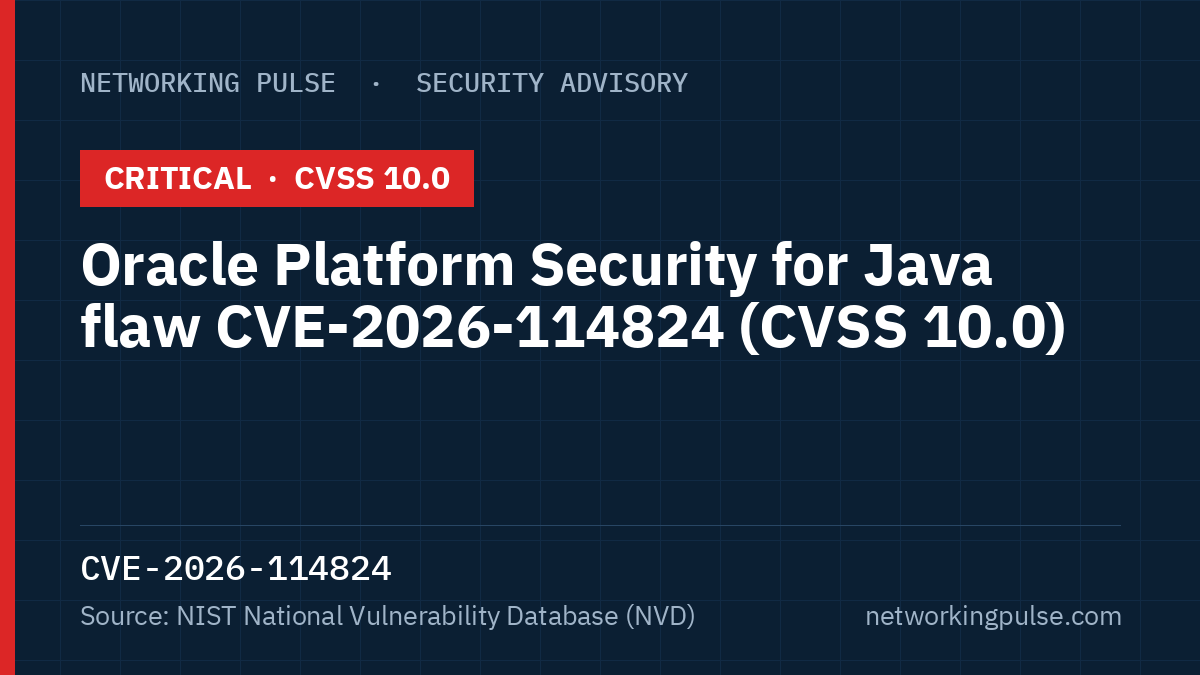
Oracle published its Critical Security Patch Update (CSPU) for November 2026 on 17 November 2026. It includes CVE-2026-114824, a flaw in Oracle Platform Security for Java, part of Oracle Fusion Middleware. Oracle gives it a CVSS 3.1 base score of 10.0, the highest possible score. An attacker needs no account and no user action. The supported versions affected are 12.2.1.4.0 and 14.1.2.0.0.
Advisory details
| Field | Value (as published by Oracle) |
|---|---|
| Advisory | Oracle Critical Security Patch Update Advisory - November 2026 |
| Release | 2026-November-17, Rev 1 (Initial Release) |
| CVE ID | CVE-2026-114824 |
| Product | Oracle Platform Security for Java (Oracle Fusion Middleware) |
| Component | Centralized Thirdparty Jars |
| Protocol | HTTP |
| Remote exploit without authentication | Yes |
| CVSS 3.1 base score | 10.0 |
| CVSS 3.1 vector | CVSS:3.1/AV:N/AC:L/PR:N/UI:N/S:C/C:H/I:H/A:H |
| Notes | None listed |
| Patch Availability Document | My Oracle Support document CPU450 (Fusion Middleware) |
What the advisory says
Oracle's description of the flaw, as published in the NVD record, reads:
Easily exploitable vulnerability allows unauthenticated attacker with network access via HTTP to compromise Oracle Platform Security for Java. While the vulnerability is in Oracle Platform Security for Java, attacks may significantly impact additional products (scope change). Successful attacks of this vulnerability can result in takeover of Oracle Platform Security for Java.
Oracle does not name the third-party library behind the flaw. It also publishes no further technical details. The component name shows that the issue sits in third-party Java libraries that Oracle ships with the product.
Affected versions
The table reproduces the vendor's affected-versions entry for this CVE.
| Product | Supported versions affected | Fix |
|---|---|---|
| Oracle Platform Security for Java | 12.2.1.4.0 | November 2026 CSPU patch (see My Oracle Support document CPU450) |
| Oracle Platform Security for Java | 14.1.2.0.0 | November 2026 CSPU patch (see My Oracle Support document CPU450) |
Oracle notes that it tests only versions under Premier Support or Extended Support. It says earlier releases are likely also affected and recommends upgrading to a supported version.
Other entries for the same component
The same update lists three more flaws in the same product and component. All affect versions 12.2.1.4.0 and 14.1.2.0.0 over HTTP without authentication.
- CVE-2026-91548: CVSS 3.1 score 8.6, high confidentiality impact.
- CVE-2026-91551: CVSS 3.1 score 7.5, high confidentiality impact.
- CVE-2026-91560: CVSS 3.1 score 6.5, high confidentiality and low integrity impact.
Workarounds
Oracle lists no workaround specific to this CVE. Its general guidance is to apply the patches as soon as possible. Until then, blocking the network protocols an attack needs may reduce the risk. Oracle warns that this can break application functionality. It recommends testing on non-production systems and says it is not a long-term solution.
Exploitation status
CVE-2026-114824 is not listed in the CISA Known Exploited Vulnerabilities catalog (catalog version 2026.11.17). The Oracle advisory does not report attacks for this CVE. It is not known to be exploited. Absence from the catalog does not prove that no attacks have happened.
Terms explained
- Oracle Platform Security for Java (OPSS): the security framework of Oracle Fusion Middleware. It handles authentication, authorization, credential storage and auditing for Java applications.
- Oracle Fusion Middleware: Oracle's family of application server and integration products, such as WebLogic Server and SOA Suite.
- Centralized Thirdparty Jars: the shared open-source Java libraries (JAR files) that Oracle bundles with the product.
- CSPU: Oracle's monthly Critical Security Patch Update. It complements the quarterly Critical Patch Update (CPU).
- CWE: neither Oracle nor NVD assigns a weakness (CWE) category to this CVE.
- AV:N (Attack Vector: Network): the attack works remotely over a network.
- AC:L (Attack Complexity: Low): no special conditions are needed.
- PR:N (Privileges Required: None): the attacker needs no account.
- UI:N (User Interaction: None): no user has to click or open anything.
- S:C (Scope: Changed): a successful attack can affect components beyond OPSS itself.
- C:H / I:H / A:H: high impact on confidentiality, integrity and availability.
What This Means for IT Teams
Organisations that run Oracle Fusion Middleware 12.2.1.4.0 or 14.1.2.0.0 with Oracle Platform Security for Java are in scope. Check the installed version and patch level in each Fusion Middleware home, including those under products that embed it.
The fix is the November 2026 patch set listed in My Oracle Support document CPU450. Oracle also advises applying Fusion Middleware patches to components embedded in Oracle E-Business Suite and Oracle Enterprise Manager. Releases outside Premier or Extended Support receive no patch, so an upgrade is the remediation path there.
The flaw needs only HTTP access, with no credentials and no user action. Restricting HTTP access to these servers is an interim measure only. There is no known attack activity listed by CISA for this CVE. Tracking these servers in a vulnerability management process helps confirm that every affected home receives the patch.
NVD cross-check
The NVD record was published on 17 November 2026 and has the status "Received". NVD shows Oracle's own CVSS 3.1 score of 10.0 with the same vector. NVD lists no CVSS 4.0 score and no CWE. Its description names the same product, component and versions as the Oracle advisory. NVD has not yet added its own analysis or affected-product (CPE) data.
Related coverage
Another unauthenticated flaw with a CVSS score of 10.0: Cisco FMC authentication bypass CVE-2026-20079 in CISA KEV (CVSS 10.0).