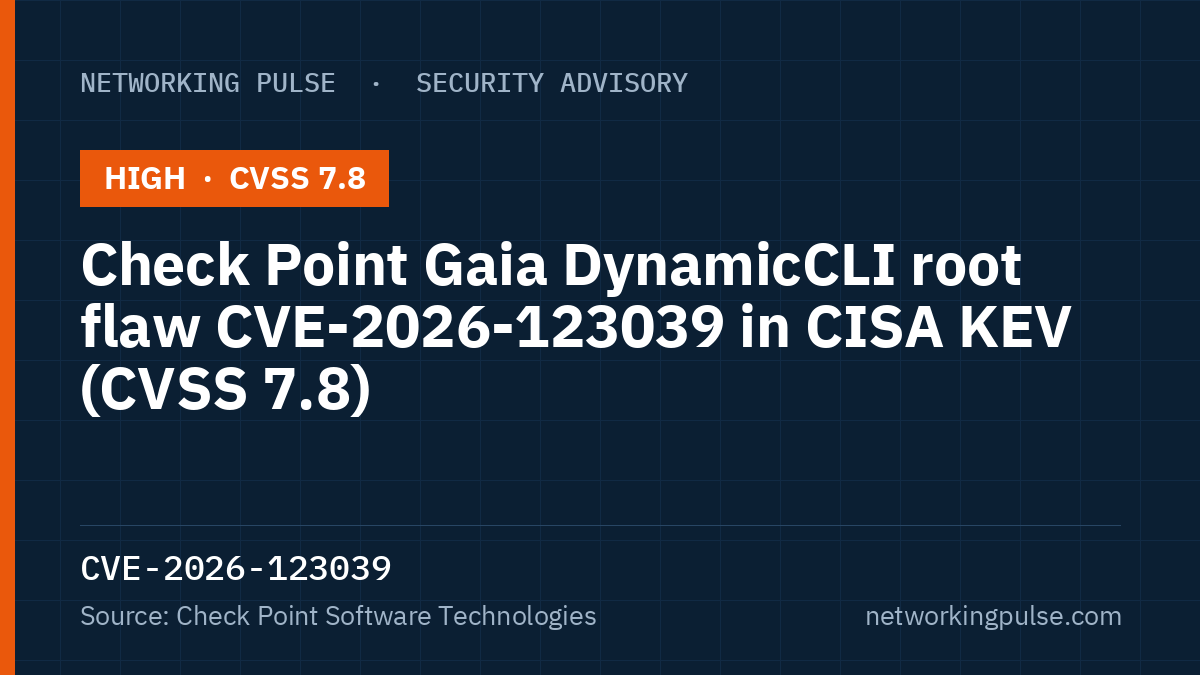
Check Point published support article sk1000362 for CVE-2026-123039. The flaw is a local privilege escalation to root in the Gaia OS DynamicCLI process. CISA added CVE-2026-123039 to its Known Exploited Vulnerabilities (KEV) catalog on 2026-11-13. Check Point says it observed an active exploit against a couple of dozen customers.
Advisory at a glance
| Field | Value |
|---|---|
| Advisory | sk1000362 (Check Point Support Center) |
| Title | CVE-2026-123039 - Local privilege escalation to root in the DynamicCLI process via local world-writable control socket |
| Created / last modified | 2026-11-08 / 2026-11-12 |
| Category and severity | Alert, HIGH |
| CVE | CVE-2026-123039 |
| CVSS | CVSS 3.1 base score 7.8 (High), vector CVSS:3.1/AV:L/AC:L/PR:L/UI:N/S:U/C:H/I:H/A:H |
| Weakness | CWE-732 and CWE-862 |
| Exploitation | Listed in CISA KEV (added 2026-11-13, due date 2026-11-16). Check Point observed an active exploit against a couple of dozen customers. |
| Applies to | Security Gateway, Security Management Server, Multi-Domain Security Management Server, Check Point Firewall, Scalable Platforms |
What the vulnerability is
The Gaia OS dynamic (extended) CLI is served by a root process called dynamic_server. It listens on a local Inter-Process Communication (IPC) socket, /tmp/dynamic_socket.
On affected products, the socket is created world-writable (0777). The daemon does not authenticate the connecting process. It executes whatever command string it receives as root.
As a result, any authenticated local user can run arbitrary commands as root by writing a single request to the socket. Check Point states that the attacker must already have local code execution on the appliance.
Affected products
- Check Point Force Firewalls
- Check Point Management and Log Servers
- Multi-Domain Security Management and Multi-Domain Log Server
- Maestro Orchestrator
Not affected: Check Point Spark Firewalls and Smart-1 Cloud.
Affected versions and fixes
| Version | Affected | Fixed in |
|---|---|---|
| R82.20 | Yes | Jumbo Hotfix Accumulator for R82.20, starting from Take 14 |
| R82.10 | Yes | Jumbo Hotfix Accumulator for R82.10, starting from Take 52 |
| R82 | Yes | Jumbo Hotfix Accumulator for R82, starting from Take 132 |
| R81.20 | Yes | Jumbo Hotfix Accumulator for R81.20, starting from Take 174 |
| R81.10 (EOS) | Yes | No fix listed in sk1000362 |
| R81 (EOS) | Yes | No fix listed in sk1000362 |
The advisory says the fix blocks and logs unauthenticated calls to the Dynamic CLI command. A blocked call appears in /var/log/dynamicCli.log as "Rejected connection from unauthorized uid". A non-zero or unexpected UID in these lines (for example, 99 = nobody) indicates a blocked escalation attempt.
To confirm a box is fixed, Check Point says ls -l /tmp/dynamic_socket should show srw-rw---- root config (0660), not srwxrwxrwx (0777).
Mitigation
Check Point's mitigation is to stop the dynamic_server process and prevent it from restarting. The commands are dbset process:dynamic_server followed by dbset :save.
Stopping the process causes the Dynamic CLI commands listed in sk144112 to fail. To re-enable it, run dbset process:dynamic_server t followed by dbset :save. To check whether the process is running, run ps auxw | grep -v grep | grep 'dynamic_server' in Expert mode.
Indicators of compromise
The daemon logs every command it receives to /var/log/dynamicCli.log. Legitimate requests use a Clish wrapper that contains CPprofile.sh >> /dev/null; export SP_DISTRIBUTE=0; set -o noglob;. Check Point says any command without this wrapper may indicate a command run as root through the socket and requires investigation.
The advisory lists three checks to run on each Check Point Force Firewall or cluster member:
- Search the log for "Received =" lines that do not use the expected Clish wrapper.
- Search for "Received = #return_value#", which marks use of the
system()sink. Check Point says this is uncommon or absent in legitimate traffic. - Search for commands commonly associated with attack attempts, such as
whoami,/etc/shadow,ncat,/dev/tcp,curl,wget,base64,useraddandauthorized_keys.
Check Point also advises correlating bursts of rejected connections with portal, web and authentication logs to identify the source.
CISA KEV listing
CISA lists CVE-2026-123039 as "Check Point Multiple Products Incorrect Permission Assignment for Critical Resource Vulnerability". It was added on 2026-11-13 with a due date of 2026-11-16. Known ransomware campaign use is "Unknown". Forensic triage is marked "Yes".
CISA's required action is to apply mitigations per vendor instructions, following BOD 26-04 guidance, or to discontinue use of the product if mitigations are unavailable.
Terms explained
- Gaia OS: the operating system of Check Point security gateways and management servers.
- Dynamic CLI: extended Gaia Clish commands served by the
dynamic_serverdaemon (described in sk144112). - IPC socket: a local file-like endpoint that lets processes on the same machine send data to each other.
- World-writable (0777): file permissions that let every local user read, write and execute the file.
- Jumbo Hotfix Accumulator (Take): Check Point's cumulative hotfix package; each release is a numbered "Take".
- CWE-732: Incorrect Permission Assignment for Critical Resource.
- CWE-862: Missing Authorization.
- CVSS vector: AV:L (local attack vector), AC:L (low attack complexity), PR:L (low privileges required), UI:N (no user interaction), S:U (scope unchanged), C:H/I:H/A:H (high impact on confidentiality, integrity and availability).
What This Means for IT Teams
Organisations running Check Point Force Firewalls, Management and Log Servers, Multi-Domain servers or Maestro Orchestrator on R81 through R82.20 are in scope. Spark Firewalls and Smart-1 Cloud are not affected.
The fix is a Jumbo Hotfix Accumulator take at or above the build listed for each version. R81.10 and R81 are end of support, and the advisory lists no fix for them. Where a hotfix cannot be installed yet, the vendor workaround is to stop the dynamic_server process, which disables the Dynamic CLI commands.
An attacker needs local access with an authenticated account first. Even so, the flaw is on the CISA list of known exploited vulnerabilities, and the vendor reports active attacks. Reviewing the DynamicCLI log with the vendor's checks fits into routine vulnerability management and network monitoring of the appliances.
NVD cross-check
NVD lists the record as Analyzed, published 2026-11-12 and last modified 2026-11-16. Its description matches the vendor's. The only CVSS score is Check Point's CVSS 3.1 score of 7.8 (High), with the same vector. NVD lists no CVSS 4.0 score. The weaknesses (CWE-732, CWE-862) match.
NVD's affected-version data names two products, Quantum Security Gateway and Quantum Security Management. It lists R82.10 with Jumbo Hotfix Take 50 or below, R82.20 with Take 10 or below, R82 with Take 130 or below and R81.20 with Take 173 or below. The vendor's fixed takes are 52, 14, 132 and 174. NVD's data does not state the status of the takes in between (51, 11-13, 131). Follow the vendor's fixed builds.
NVD's CPE configuration covers Gaia OS from R81 up to R82.20 builds on listed Quantum, Quantum Force, Maestro Hyperscale Orchestrator and Smart-1 appliances. The vendor also lists R81.10 and R81 as affected, which the NVD affected-version data does not name.
Related coverage: FortiOS cw_acd heap overflow CVE-2025-25249 added to CISA KEV.