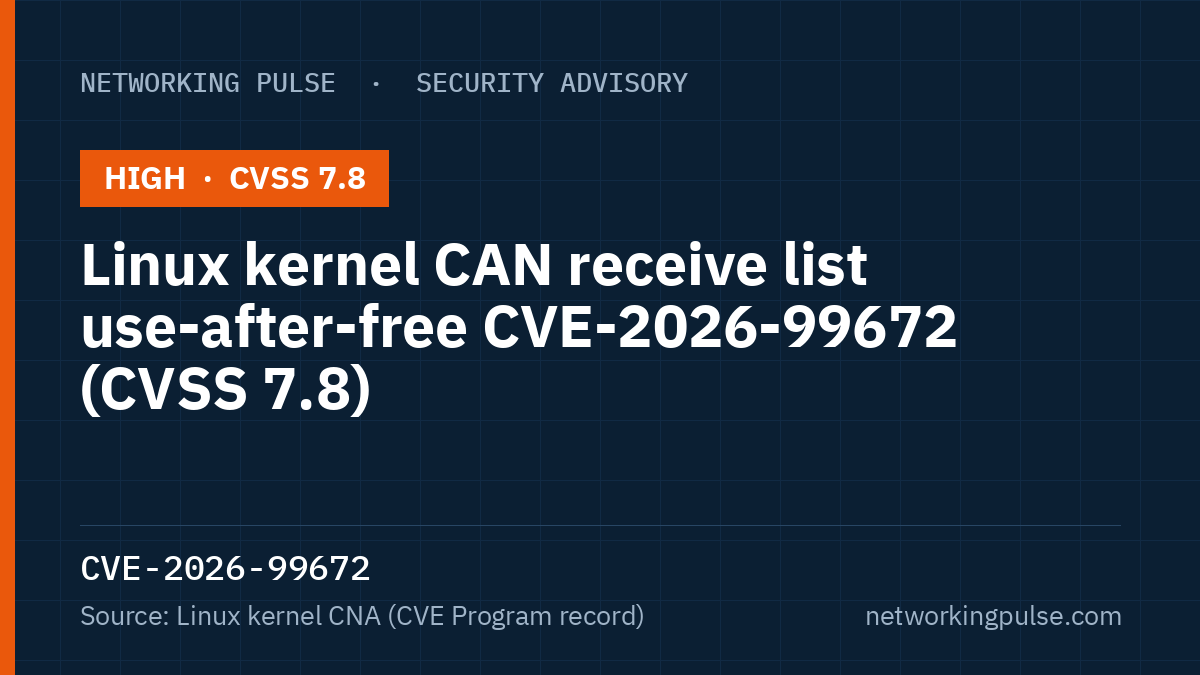
On 2026-11-20 the Linux kernel CNA published CVE-2026-99672, a use-after-free in the kernel's CAN socket layer with a CVSS 3.1 score of 7.8 (High). It involves the locking of CAN receive lists when a device changes network namespace. Fixed releases are 6.12.118, 6.18.64, 7.3.5 and 7.4-rc2.
Advisory details
- CVE: CVE-2026-99672 (the only CVE in this record)
- Assigner: Linux (the Linux kernel CNA)
- Published: 2026-11-20; last updated 2026-11-22
- Product: Linux kernel, files include/linux/can/can-ml.h, include/net/netns/can.h, net/can/af_can.c, net/can/bcm.c, net/can/isotp.c, net/can/raw.c
- CVSS: 3.1 base score 7.8 (High), vector CVSS:3.1/AV:L/AC:L/PR:L/UI:N/S:U/C:H/I:H/A:H, assigned by the Linux CNA
- CWE: none listed in the record
- Exploitation status: Not known to be exploited. The CVE is not listed in the CISA Known Exploited Vulnerabilities (KEV) catalog, version 2026.11.20.
- Workarounds: none listed in the record
What the flaw is
Each CAN device keeps its receive lists in its own private data, and those lists move with the device into another network namespace. Until the fix, they were guarded by a lock that belongs to the namespace instead. can_rx_unregister() therefore needs the device's current namespace to pick the lock, and it silently returns if the namespace it is given no longer matches.
isotp_release() and bcm_release() leave their notifier list before taking a lock that serialises against the device notifier. If the bound device moves to another namespace in that window, the release path must remove the filters itself, but the namespace check fails and the removal is skipped. can_rx_register() stores the socket pointer without a reference, so the remaining receivers point to the freed ISO-TP socket or BCM operation. The record includes a KASAN report of a use-after-free read in isotp_rcv().
The fix adds a spinlock to each CAN device's receive lists, so unregistration finds the subscription whatever namespace the device is in. CAN_RAW, CAN_BCM and CAN_ISOTP now pass the namespace used at registration. Several bind, setsockopt and release paths no longer need RTNL.
The CNA's scenario has an attacker create a virtual CAN (vcan) device, bind an ISO-TP or BCM socket, and race close() against moving the device to another namespace. Creating the socket needs no capability. Moving the device needs CAP_NET_ADMIN only inside a user namespace, which an unprivileged user can own. The freed object can then be read or written, or the kernel can oops or hang.
Affected and fixed versions
This table reproduces every version entry in the Linux CNA record.
| Kernel version or range | Status in the record |
|---|---|
| Earlier than 4.12 | Unaffected |
| 4.12 and later | Affected, unless at or above a fixed version below |
| 6.12.118 and later 6.12.x | Unaffected (fixed) |
| 6.18.64 and later 6.18.x | Unaffected (fixed) |
| 7.3.5 and later 7.3.x | Unaffected (fixed) |
| 7.4-rc2 and later | Unaffected (original mainline fix) |
The record lists 4 fix commits in the stable tree: 59d91f555ada, 4b625dde57c0, 228e795ec650, 0f3ad9ab40e3. The issue was introduced by commit 8e8cda6d737d.
Terms explained
- Network namespace: an isolated copy of the network stack with its own devices and settings.
- User namespace: an isolated set of user and capability IDs; its root user has capabilities only inside it.
- Receive list: the kernel's list of filters that decides which sockets receive which CAN frames.
- ISO-TP and BCM: CAN socket protocols: ISO-TP carries messages longer than one frame, and the broadcast manager (BCM) sends and filters frames on a schedule.
- RTNL: the routing netlink lock, a global lock for network configuration changes.
- KASAN: the Kernel Address Sanitizer, a debugging tool that detects invalid memory accesses.
- Use after free: memory is used after it has been released.
- CVSS vector AV:L/AC:L/PR:L/UI:N/S:U/C:H/I:H/A:H: the attacker needs local access with a low-privileged account (AV:L, PR:L); the attack is not complex (AC:L) and needs no user interaction (UI:N); the impact stays in the kernel (S:U); confidentiality, integrity and availability impact is high (C:H/I:H/A:H).
What This Means for IT Teams
The changed files are in net/can/ and the CAN headers, and kernels from 4.12 onward fall within the affected range. The scenario relies on unprivileged user namespaces and a virtual CAN device, so hosts that let unprivileged users create user namespaces are the relevant case.
Updated kernels are 6.12.118, 6.18.64 and 7.3.5 or later on those branches, and 7.4-rc2 or later. Check the running version against the table. The record gives no workaround.
Local code execution is required. The CVE does not appear in the CISA KEV catalog. Timely kernel updates on multi-user hosts are part of patch management for server infrastructure.
NVD cross-check
NVD lists the CVE as "Received" and reproduces the CNA's text, affected versions and 7.8 vector unchanged, credited to the Linux CNA. There is no separate NVD assessment, CWE or CPE yet, so there is nothing to reconcile.