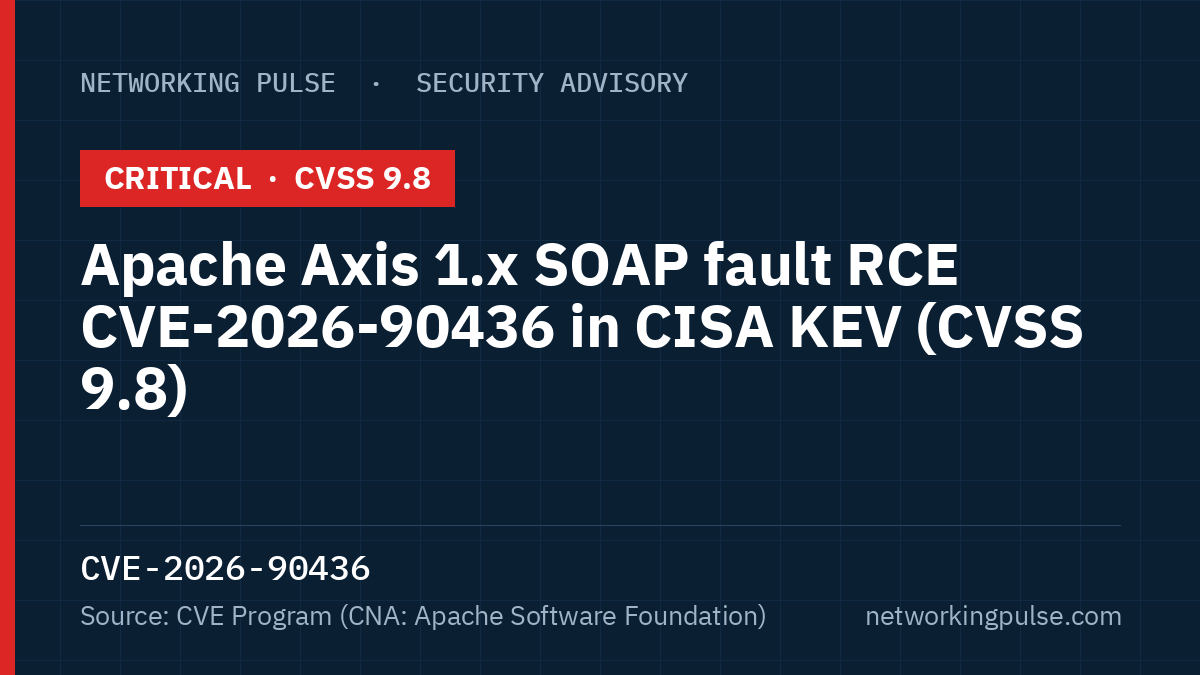
CVE-2026-90436 is an unsafe reflection vulnerability in Apache Axis 1.x, a Java SOAP engine that has reached end of life (EOL). An unauthenticated attacker can make Axis load and instantiate a class named in a SOAP fault message. With a suitable class on the application's classpath, this leads to remote code execution. Apache rates it critical; the CVSS 3.1 score is 9.8. CISA added it to its Known Exploited Vulnerabilities (KEV) catalog on 18 November 2026, so it is known to be exploited. Apache does not expect to release a fixed Axis 1.x version.
Advisory details
Apache published the CVE record as CNA on 2026-11-06; NVD also references an Apache mailing-list post as the vendor advisory. The facts below come from the CVE record, NVD and the CISA KEV feed.
| Field | Value |
|---|---|
| CVE ID | CVE-2026-90436 |
| Title | Apache Axis 1.x (EOL): unauthenticated remote class instantiation via SOAP fault exceptionName |
| Assigning CNA | Apache Software Foundation |
| CVE record published | 2026-11-06 |
| Tag | Unsupported when assigned |
| Apache severity | Critical |
| CVSS 3.1 score | 9.8 Critical (scored by CISA ADP; Apache published no CVSS score) |
| CVSS 3.1 vector | CVSS:3.1/AV:N/AC:L/PR:N/UI:N/S:U/C:H/I:H/A:H |
| Weakness | CWE-470: Use of Externally-Controlled Input to Select Classes or Code ('Unsafe Reflection') |
| Authentication needed | None; per-service authentication handlers do not protect against it |
| User interaction | None (UI:N) |
| Fixed release | None planned; migrate, or build Axis with the upstream patch |
| Credit | José Apari-Pantigozo from OKIOK (finder) |
| CISA KEV | Added 2026-11-18; due date 2026-11-21; known ransomware campaign use: Unknown |
What the advisory says
According to Apache, the problem is in how Axis 1.x reads an incoming SOAP fault:
- If the fault's detail section contains an exceptionName element, Axis loads the class with that name.
- If a String data element is also present, Axis creates an object of that class through its String constructor.
- Both steps happen before Axis checks that the class is an AxisFault.
- Loading the class alone runs its static initializer.
- The fault is read while Axis resolves the target service, before any per-service handler chain. Authentication handlers on a service therefore do not stop it.
Apache states: "With a suitable class on the application's classpath this leads to remote code execution."
Affected versions
The CVE record lists every affected entry below. NVD's analysed configuration covers Apache Axis 1.0 through 1.4 (including 1.4).
| Product | Package or repository | Affected | Fix |
|---|---|---|---|
| Apache Axis 1.x (EOL) | Maven axis:axis | Through 1.4 | No release planned |
| Apache Axis 1.x (EOL) | Maven org.apache.axis:axis | Through 1.4 | No release planned |
| Apache Axis 1.x (EOL) | Git axis-axis1-java | From commit aac718c6035435d96b39d6aebb9c078a13af7cc8, before 41f3b4e8d04e310ca81f86b92630ab2c11d608bd | Commit 41f3b4e8d04e310ca81f86b92630ab2c11d608bd |
Remediation
- Migrate to a different SOAP engine. Apache names Apache Axis 2/Java as an example.
- Or use a build of Axis with the patch from commit 41f3b4e8d04e310ca81f86b92630ab2c11d608bd applied (https://github.com/apache/axis-axis1-java/commit/41f3b4e8d04e310ca81f86b92630ab2c11d608bd).
Apache does not expect to create an Axis 1.x release that fixes the problem.
Exploitation status
CISA lists CVE-2026-90436 in its KEV catalog. It was added on 2026-11-18, with a due date of 2026-11-21. Known ransomware campaign use is listed as Unknown. CISA notes that the product could be end-of-life and advises users to stop using it or move to a supported version. CISA also notes that the flaw could affect an open-source component, third-party library, protocol or proprietary implementation used by different products. Its required action is to apply mitigations per vendor instructions, following its BOD 26-04 guidance and forensics triage requirements, or to stop using the product if mitigations are unavailable.
Terms explained
- Apache Axis 1.x: a Java SOAP engine for web services. Apache names Apache Axis 2/Java as an alternative SOAP engine to migrate to.
- SOAP and SOAP fault: SOAP is an XML message format for web services. A fault is the SOAP message that reports an error.
- Classpath: the set of Java classes and libraries an application can load.
- Static initializer: Java code that runs once when a class is loaded. Here, loading alone runs it.
- EOL and "unsupported when assigned": the product no longer receives maintenance, and was already unsupported when the CVE was assigned.
- CWE-470 (Unsafe Reflection): the software uses outside input to choose which class or code to load.
- AV:N (Attack Vector: Network): the attack can be sent over the network.
- AC:L (Attack Complexity: Low): no special conditions are needed beyond those stated.
- PR:N (Privileges Required: None): no account is needed.
- UI:N (User Interaction: None): no user has to click or open anything.
- S:U (Scope: Unchanged): the impact stays within the vulnerable component.
- C:H/I:H/A:H: high impact on confidentiality, integrity and availability.
- KEV: CISA's Known Exploited Vulnerabilities catalog.
What This Means for IT Teams
Any Java application that includes Apache Axis 1.x, up to and including 1.4, is in scope. The affected Maven packages are axis:axis and org.apache.axis:axis. CISA notes that other products may embed the component, so third-party software can be affected too.
There is no fixed 1.x release to deploy. The options are migrating to another SOAP engine, such as Apache Axis 2/Java, or running a build of Axis that includes the upstream patch commit.
No login and no user action are needed. Authentication handlers on individual services do not help, because the fault is parsed before they run. A suitable class must be on the application's classpath for code to run. CISA lists the issue as known exploited, so finding every application that bundles Axis 1.x is part of vulnerability management for this issue.
NVD cross-check
NVD lists CVE-2026-90436 as Analyzed, published 2026-11-06 and last modified 2026-11-19. Its description matches Apache's text. NVD shows a CVSS 3.1 score of 9.8 Critical (CVSS:3.1/AV:N/AC:L/PR:N/UI:N/S:U/C:H/I:H/A:H) from CISA ADP, and no CVSS 4.0 score. The weakness is CWE-470, from Apache. NVD's configuration lists Apache Axis 1.0 through 1.4; the CVE record says "through 1.4" without a lower bound. NVD also shows the KEV dates: added 2026-11-18, due 2026-11-21.
Related coverage: Oracle Platform Security for Java flaw CVE-2026-114824.